It is the question we are asked more than any other: "If I go to the Ibera Wetlands, will I see a jaguar?" Here is the honest answer, the one a tour brochure will not give you: almost certainly not. And once you understand why, you may find that it is the best reason to go.
The short, honest answer
The jaguar is back in Iberá. That alone is remarkable, because for about 70 years there were none. But "back" means roughly 50 free-ranging animals spread across a reserve of about 1.3 million hectares. Do the math and the odds of crossing paths with one on a few days of boat trips and walks are very low. People who work in the wetland every day go years between sightings.
So if your single goal is to photograph a wild jaguar, this is not the trip, and we say so plainly in our full comparison of Iberá and the Pantanal. You go to Iberá for something different: to stand in a place where one of the most ambitious wildlife comebacks on the planet is happening, and to see an extraordinary amount of other wildlife up close while you are there.
Why the jaguar vanished, and how it came back
Hunting and habitat loss wiped the jaguar out of this corner of Argentina decades ago. Since 2012, the organization Rewilding Argentina, born from the conservation projects of Douglas and Kristine Tompkins, has worked to bring it back, breeding and preparing animals at a reintroduction center on San Alonso Island, deep inside the wetland.
The first jaguars walked free in Iberá in 2021. Since then the population has grown across several generations to at least 50 alive today, and biologists believe the wetland can eventually hold around 100. The project is now so successful that a wild-born Iberá jaguar was released into the wild in 2025 to help start a new population in the Gran Chaco, the first wild-to-wild jaguar translocation in the country.
That is the story you come to feel a part of. It is not a zoo and it is not a guarantee. It is a wild animal, doing wild-animal things, across an area the size of a small country.
What your realistic odds are, and how to improve them
Let us be clear: there is no portal, no lodge and no guide that can promise you a jaguar in Iberá. What you can do is tilt the odds slightly in your favor.
- Go in the dry season (roughly May to October), when wildlife concentrates around shrinking water and conditions are best.
- Be out at dawn and dusk, when cats are most active.
- Give it time. A single afternoon outing is a lottery ticket; several days of early starts is a better one.
- Go with expert local guides. The people who track and monitor these animals know the terrain and the recent signs better than anyone, and a few operators run specialized wildlife-tracking outings.
Even doing all of that, treat any jaguar sighting as a once-in-a-lifetime stroke of luck, not a line item on your itinerary. Manage your expectations and Iberá will exceed them.
What you will actually see (and why it is enough)
Here is the part the jaguar question overshadows. The wildlife you are almost guaranteed to see in Iberá, often within a few meters and with no telephoto lens, is genuinely world-class, and we have broken it down species by species in what you will actually see in Iberá:
- Capybaras everywhere, the world's largest rodent, grazing the banks at sunset, so relaxed they barely look up.
- Caimans (yacarés) basking on the shore and drifting through the channels.
- Marsh deer, the largest deer in South America, wading the flooded grasslands.
- Giant anteaters, themselves a rewilding success, snuffling across the open country.
- Howler monkeys booming from the gallery forest at dawn.
- Rheas striding the grasslands, and more than 350 bird species, from the jabiru stork to the scarlet-headed blackbird.
A sunrise boat ride here is not a tense jaguar stakeout. It is a slow, close, generous encounter with a whole living wetland. That is the trip.
The bottom line
Come to Iberá to witness a landmark rewilding story and to see capybaras, marsh deer, caimans, anteaters and hundreds of birds at arm's length. Come hoping to glimpse a jaguar, by all means, but do not come expecting one. The travelers who leave happiest are the ones who understood the odds before they arrived. If a guaranteed big cat is what you are after, the Pantanal is your trip; if a wild, quiet, affordable wetland on the rise is what you want, this is it. We break down what an independent Iberá trip actually costs separately.
Frequently asked questions
How many jaguars are there in Iberá?
At least 50 free-ranging animals as of 2026, up from zero before the reintroduction, spread across roughly 1.3 million hectares. Biologists estimate the wetland can eventually support about 100.
What are my chances of seeing one?
Low. With a few dozen wide-ranging animals across an enormous reserve, even people who work in Iberá go long stretches without a sighting. Treat it as a rare bonus, not a plan.
Can I book a jaguar safari in Iberá?
You can book wildlife outings with expert local guides who know where animals have recently been active, which improves your odds at the margins, but no one can guarantee a jaguar. The honest pitch is a wildlife and rewilding experience, not a guaranteed cat.
When is the best time to try?
The cool, dry months from about May to October, at dawn and dusk, over several days rather than one outing.
If not a jaguar, what will I see?
Capybaras, caimans, marsh deer, giant anteaters, howler monkeys, rheas and more than 350 bird species, usually easily and up close.
Iberá Experience is the free guide app to the Ibera Wetlands. It shows you which of the ten gateway portals to choose, where to stay, and who runs the boat safaris, birding walks and wildlife outings, with direct contact for each one. No sign-up, and it works straight from your browser. Start at iberaexperience.com.
Sources, last checked June 2026: Iberá jaguar population, reintroduction timeline and translocations (Rewilding Argentina, Tompkins Conservation, Mongabay, Noticias Ambientales); Iberá reserve area and wildlife (Wikipedia, Buenos Aires Herald birding series).
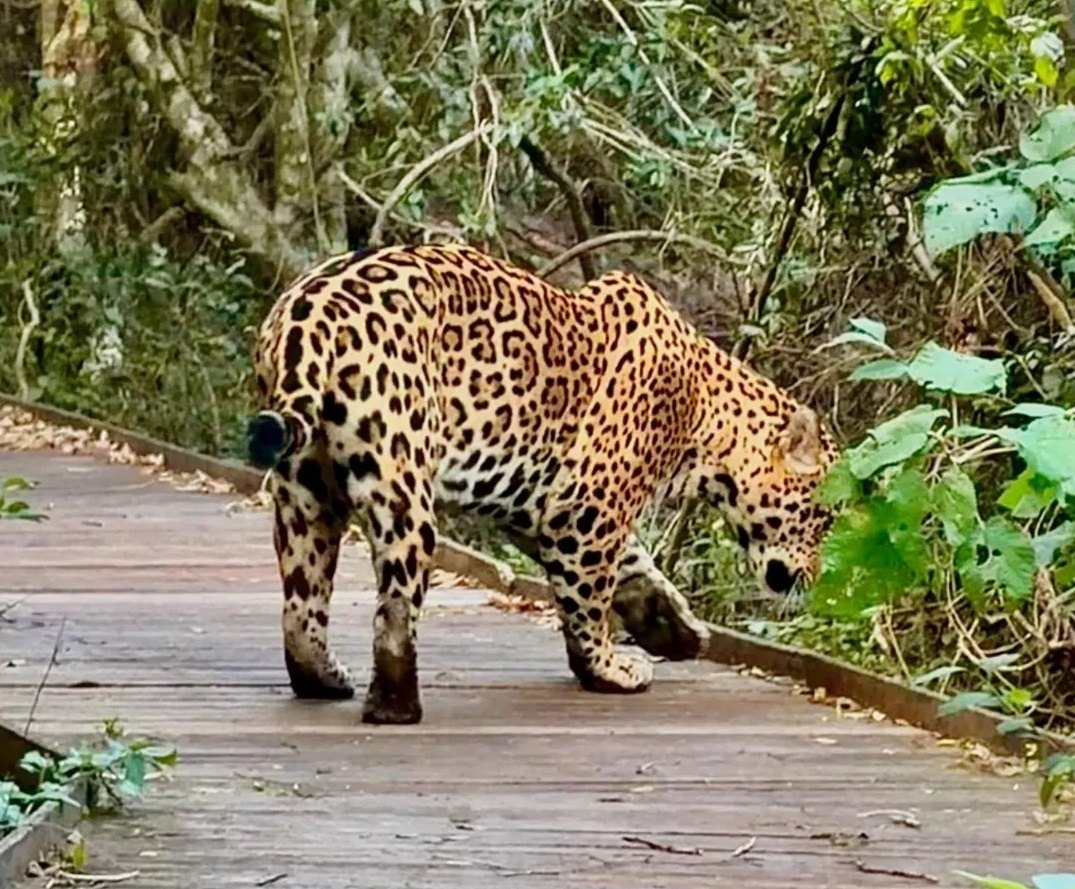
Photo credits: Mariua and her cubs at their 2021 release, Rewilding Argentina; jaguar on a boardwalk in the Iberá reserve, Oscar Edgardo Fernández.
Start planning your Iberá trip
Free, no download and no sign-up: the app that gathers all 10 access portals and more than 500 local providers of the wetlands.
Open Iberá Experience