Planning your trip
How do you get to the Esteros del Iberá?
To reach Carlos Pellegrini, the main gateway to the Iberá, you have three options:
🚌 Bus + shuttle: from Buenos Aires take a long-distance coach from Retiro to Mercedes (Corrientes). From Mercedes, IberáBus runs a shuttle to Carlos Pellegrini on Mondays, Wednesdays and Fridays, once a day. Check the schedules and book through their Instagram (button below).
🚐 Bus + private transfer: take the coach to Mercedes and from there hire a transfer to Pellegrini (120 km, about 3 hours). In the app you have several providers that cover the Mercedes to Pellegrini leg.
🚗 By car: from Mercedes it is 120 km along RP 40: 40 km paved and 80 km of gravel. It is the most popular option for those traveling on their own.
The other gateways are also organized from Mercedes or from the airports of Corrientes and Posadas.
What is the best time to visit the Iberá?
The Iberá can be visited all year round: there is no season when the wetland closes or the wildlife disappears. What changes is the character of the trip.
🦌 April to August is the best time for wildlife: the rains ease off, the water recedes and animals gather near the permanent lagoons and channels. Mild days, cool nights, clear skies and almost no mosquitoes.
🌸 September to November is when the wetland blooms: sarandí shrubs, ingá trees and the last lapachos in flower, birds in full breeding season and the red macaws of Cambyretá very active. The best known gateways fill up, so book ahead.
☀️ December to March is genuinely hot, with highs above 35°C, the water hyacinths carpet the lagoons in violet and the high water opens channels that are unnavigable the rest of the year. The local strategy: go out early in the morning and at dusk, and rest at midday.
The Iberá calendar shows month by month what you can see in each one.
When is high and low season in the Iberá?
The high season of the Iberá is from June to October. Winter (June to August) is a very good time: low water, concentrated wildlife, cool weather and no mosquitoes. Long weekends and July are the peaks of occupancy: book in advance. The low season (January to March) has extreme heat but also very active wildlife at dawn.
What is the weather like in the Esteros del Iberá?
The Iberá has a humid subtropical climate. Average temperature in January: 27°C, in July: 16°C. Absolute highs exceed 40°C in summer. Frosts are possible between June and August. It rains all year round, around 1,400 mm annually. Rain is concentrated between autumn and spring (March, April and October are among the wettest months) and winter is the driest part of the year, with August the driest month.
How many days should you spend in the Iberá?
The recommended minimum is 3 nights to make the most of the Iberá. In 3 days you can do 2-3 dawn and dusk excursions, trekking and relax. If you have more time, visit 2 different gateways: each has its own personality.
What are the transfers to the Iberá like?
The gateways to the Iberá are the airports of Corrientes and Posadas. From both airports you can hire private transfers directly to any gateway: you will find the options in our Transfers section. There are also regular buses that make the connection. From Buenos Aires there are direct buses to Mercedes, and from there local services to Carlos Pellegrini.
How do you get to the Iberá from Buenos Aires?
From Buenos Aires to the Iberá: option 1, fly to Corrientes or Posadas (about 1h30 flight) and from there a transfer to the gateway. Option 2, bus to Mercedes (about 9 hours) and from there a transfer to Pellegrini (about 3 hours more). The flight is the most comfortable. In the app you will find transfer operators at each gateway.
How do you get to the Iberá from the city of Corrientes?
The city of Corrientes has an airport with daily flights from Buenos Aires, Rosario and other cities. It is about 360 km from Carlos Pellegrini. From there you have private transfers to all the gateways. You can also rent a car: the road is paved almost all the way, with about 80 km of gravel on the final stretch before Pellegrini.
Why do you enter the Iberá through Mercedes?
Mercedes is the entry city to the Iberá from Buenos Aires and the south. From there you have transfers to Carlos Pellegrini (about 3 hours) and other gateways. It is also home to the shrine of Gauchito Gil, an iconic stop for thousands of pilgrims. You will find transfer options in our section.
How far in advance should you book?
It is recommended to book 2-3 weeks in advance in mid-season and 1-2 months ahead in July and on long weekends. Each provider has its own contacts: you will find them in the services section of each gateway within the app.
How much does it cost to visit the Iberá?
Prices in the Iberá vary by gateway and type of service, with options for every budget: from simple rural lodgings to premium lodges. At each gateway in the app you will find the providers with their contact details to ask about availability and current rates.
What should you bring to the Esteros del Iberá?
For the Iberá bring: lightweight clothing in neutral colors, insect repellent, sunscreen, a hat, closed comfortable shoes for the trails, and binoculars if you have them. In winter add a layer for the mornings. In summer, repellent is essential at dusk and during the night.
Are there a lot of mosquitoes in the Iberá?
Mosquitoes are most active in summer (December to March) and at dusk. With proper repellent and lightweight long clothing they are not a real problem. In the cold months (May to August) there are practically no mosquitoes. The lodgings in the Iberá always have mosquito nets.
Is the Iberá a good destination with kids?
The Iberá is ideal for families. Children are fascinated by the capybaras, caimans and monkeys so close by. The boat excursions are safe and require no special physical condition. Pellegrini is the most comfortable gateway for families with children, because of its range of services.
Is it safe to visit the Iberá? What about the caimans?
The Iberá is very safe for visitors. There is no problem with crime and the wildlife, although wild, poses no danger if distances are respected. The only animals that require care are the caiman (do not swim in lagoons without a guide) and snakes (rare on the trails). The local guides know the terrain perfectly.
How do I find providers and tourism services in the Iberá?
The app lists more than 500 providers across the Iberá, organized by gateway: lodges and inns, guides, boat tours, food, transfers, crafts and agencies.
Go to Explore, pick the gateway you are heading to and filter by category. Every listing has the direct contact (WhatsApp, phone and social media): you book straight with the provider, the app does not charge and is not a middleman. You can save the ones you like and sort them by day in "My Trip".
Tell me which gateway you are visiting and I will take you to the ones in that area.
Where to sleep and eat
Where to stay in the Iberá?
There is accommodation at every gateway, from rural inns to luxury lodges. Carlos Pellegrini has the largest offering: inns with breakfast and excursions included. At the remote gateways (Galarza, Uguay) the options are simpler but the experience is more authentic.
What do people eat in the Iberá?
The cuisine of Corrientes has its own identity. In the towns of the Iberá you can eat: reviro (a stew of flour with fat, a rural classic), chipá (cassava starch bread), locro, and above all grilled river fish. The surubí, the dorado and the pacú are the stars of any table beside the Iberá.
What is chipá?
Chipá is the traditional bread of northeastern Argentina, made with cassava starch and cheese. It has Guaraní and Jesuit roots. It is sold along the road, in the towns and at any stop on the way to the Iberá. Crunchy on the outside and soft on the inside, it is a must on any visit to the region.
What is mbejú?
The mbejú is a small cake of cassava starch and cheese, of Guaraní origin, one of the most typical flavors of the Iberá. In Loreto you have two places to try it: Comedor Doña Icha (daily criollo cooking, no menu, whatever is on that day) and Ñandegusto (a regional gastronomic experience with Valeria from the Iberá Cooks Network, by prior reservation).
Activities
What activities can you do in the Iberá?
The main activities in the Iberá are: dawn/dusk boat excursions, trekking across floating islands, photo safaris with wildlife, kayaking in the lagoons, catch-and-release sport fishing, horseback rides across grasslands and birdwatching. Each gateway has its specialty: ask me about the one you are interested in.
Do I need a guide to visit the Iberá?
The app has more than 100 Iberá guides, listed gateway by gateway along with the rest of the providers. Go to the gateway you are heading to, filter by the Guides category and you will see them all with their direct contact, to agree on the day, time and price.
At the wilder gateways it is best to arrange it before you set off: at San Nicolás, for example, providers are hired in advance and you get their contacts at the Tourist Information Office in San Miguel.
What is the boat excursion (safari) in the Iberá like?
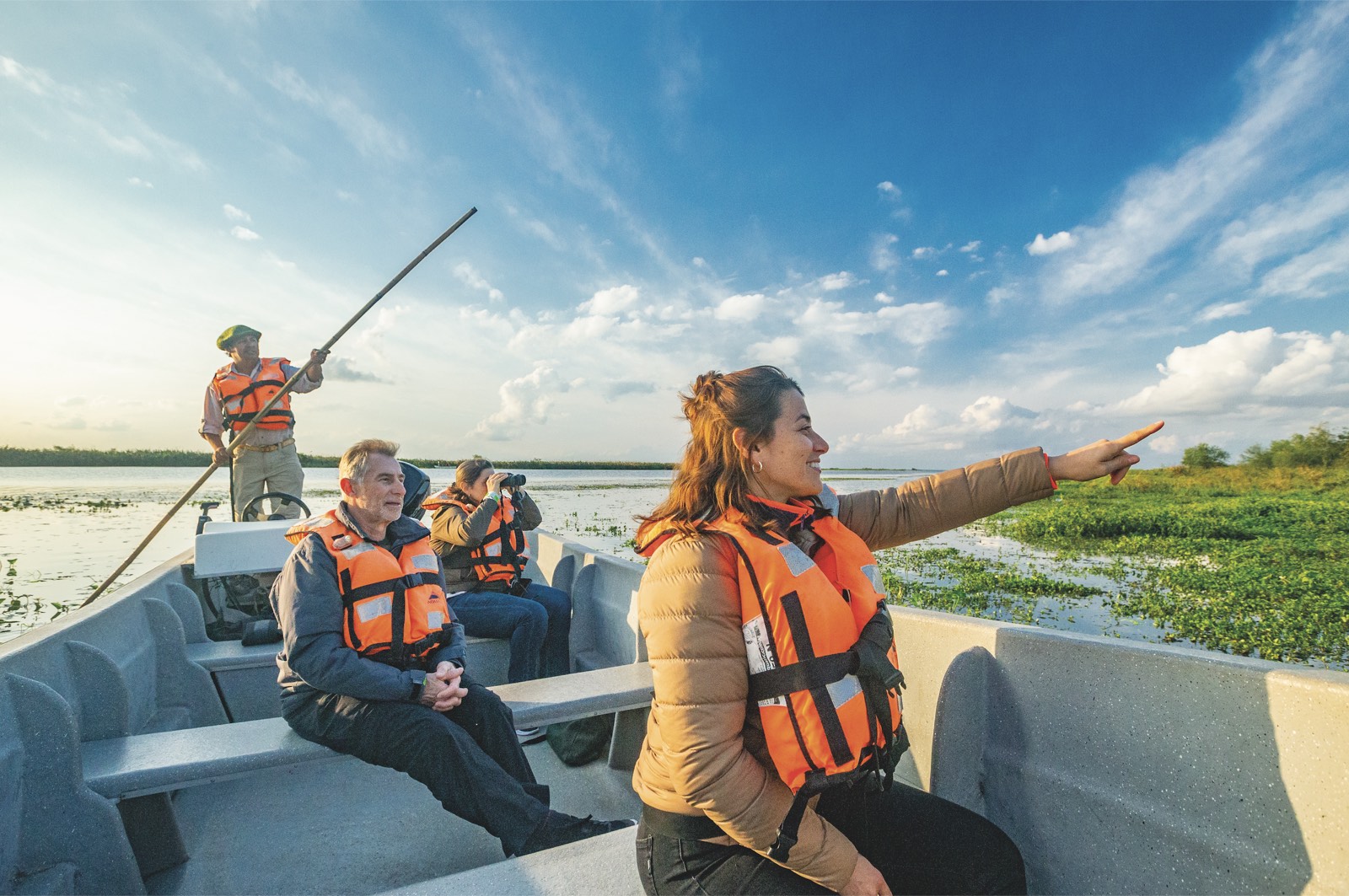
The dawn boat excursion is the star activity of the Iberá. By boat or canoe you travel the channels as the sun rises: caimans sunbathing, capybaras on the bank, herons, jacanas walking on the floating leaves. It lasts 2-3 hours and requires no prior experience. The silence of the wetland at dawn is magical.
Can you go kayaking in the Iberá?
Kayaking is one of the best ways to explore the channels of the Iberá. You paddle in silence between the floating islands, at eye level with the caimans and capybaras. The gateways that offer it are San Antonio (Loreto), San Nicolás, Capivari, Carambola and Laguna Iberá; at San Nicolás you can also go out in a poled canoe. An outing lasts 2-3 hours and requires no prior experience. From Capivari starts the Cruce de los Esteros, the long 3 to 5 day crossing to Carambola.
Are there horseback rides in the Iberá?
In the Iberá the horse is how the local baqueanos have always ridden into the wetlands, and there are four ways to experience it:
🐎 Rides of 2 or 3 hours through palm groves, grasslands and marshes, with marsh deer, capybaras and birds along the way. It is the most popular option in Carlos Pellegrini.
🏕️ Multi-day crossings from refuge to refuge, at Portal Carambola.
🌊 Swimming across on horseback and canoes towed by horse, also at Carambola.
🔥 Ranch days and gaucho experiences at estancias: a ride, farm work and criollo cooking.
These are the providers in the app that work with horses. Tap the one you like to open its listing and message them directly: you agree the day, the time and the price with them, the app does not charge or act as a middleman.
Are there trails and walks in the Iberá?
Trekking in the Iberá is a complete sensory experience. The trails cross grasslands, riverside forests and floating islands. Portal Uguay is the best for trekking, with marked trails and panoramic views of the lagoon. There are also guided walks across the floating islands in Pellegrini.
Is the Iberá good for birdwatching?
The Iberá is one of the best birdwatching destinations in Argentina: the checklist of the birds of the Iberá and Corrientes published in 2026 (Corredor Azul programme with the Iberá Birding Center) lists 496 species. Among the most sought after: the strange-tailed tyrant (Endangered in Argentina), the roseate spoonbill, the black-crowned night heron, the red-and-green macaw and the huge tuyuyú. The Carlos Pellegrini and Laguna Iberá area is the most heavily birded, with around 360 species reported on eBird. Bring binoculars.
Any photography tips for the Iberá?
For wildlife photography, the golden hours (6-8 am and 5-7 pm) are the ideal time. From the boat you get shots at water level with perfect light. Lenses of 200-400 mm are the most useful. The Iberá is one of the most generous nature photography destinations in the Americas: the wildlife is incredibly trusting.
Can you fish in the Iberá?
The Iberá and its rivers are a world-famous sport fishing destination. The dorado, the surubí and the pacú are the most sought-after species. Inside the Gran Parque only two gateways allow fishing, Río Corriente and Carambola; the rest of the fishing happens in the rivers of the province.
Mind the closed season (veda), which changes every year and is enforced: in Corrientes taking dorado and surubí out of the water is banned (catch and release only) and for the 2025-26 season the veda ran from 27 October to 6 March. Confirm the current one with the provincial Dirección de Recursos Naturales before you plan the trip. 🎣
What is dorado fishing in the Iberá like?
The dorado (Salminus brasiliensis), nicknamed "the river tiger", is the emblematic fish of sport fishing in the Iberá. It can weigh more than 20 kg and leaps spectacularly when hooked. In Corrientes taking it out of the water is banned: it is catch and release only, and there is also a closed season (the 2025-26 veda ran from 27 October to 6 March), so confirm the current one before you travel. 🎣
Portals and towns
What does Portal Laguna Iberá (Carlos Pellegrini) offer?
Carlos Pellegrini is the most complete and best-equipped gateway in the Iberá. It has boat excursions, walks across floating islands and night safaris. The dawn boat excursion is unmissable: caimans, capybaras, herons and deer just a few meters away. It is the ideal gateway for a first visit. 🌅
What is the town of Carlos Pellegrini like?
Carlos Pellegrini, in Portal Laguna Iberá, is the most visited entry point of the park. It has a population of about 1,000 people, almost all linked to tourism. Inns, lodges, restaurants and excursion operators in a dirt-road village surrounded by wetlands. The dawn boat excursion from here is the most renowned in the Iberá.
What does Portal Carambola offer?
Portal Carambola is ideal for sport fishing and aquatic wildlife watching. The dorado and the surubí are the stars of its waters. You can also take photo safaris at dawn in areas with a high density of wildlife.
What does Portal Cambyretá offer?
Portal Cambyretá is the best place to see the red-and-green macaw in free flight: it was reintroduced there in 2015, and a second nucleus was added at Yerbalito in 2026. It also has excellent conditions for watching caimans, capybaras and water birds. Its lagoons have particularly crystal-clear waters.
What does Portal Galarza offer?
Portal Galarza is in the east of the park, on the Galarza lagoon. It is a gateway that is still little developed: one family runs the excursions in this sector, ideal for those seeking an authentic experience without crowds. Marsh deer are very common here.
What does Portal San Antonio (Loreto) offer?
Portal San Antonio, accessible from Loreto, is the northern gateway to the wetlands. It offers kayaking, boat trips, criollo-style accommodation, private nature reserves and historic estancias.
What does Portal San Nicolás offer?
Portal San Nicolás, in the north of the system, is one of the most remote. It has white sand beaches on the lagoon. It is ideal for traditional canoe trips, kayaking, spotting neotropical otters, and for those seeking an Iberá without tourists.
What does Portal Río Corriente offer?
Portal Río Corriente is at the southwestern tip of the Greater Iberá Park, on the source of the Corriente River. Ideal for catch-and-release sport fishing, kayaking through the marshes and sightings of capybaras and neotropical otters in a rarely visited setting.
What does Portal Uguay offer?
Portal Uguay offers one of the best trekking experiences in the Iberá. Its trails cross grasslands and woodlands with panoramic views of the lagoon. Ideal for observing grassland birds such as the strange-tailed tyrant, a threatened grassland bird with a racket-shaped tail.
What does Portal Capivarí offer?
Portal Capivari is the southern gateway of the park and the starting point of the Cruce de los Esteros, a 3 to 5 day crossing paddling streams and lagoons (Trim, Medina) until you come out at Portal Carambola. You can also go for the day: kayaking, boat trips and camping on the islands. Its most visible wildlife are the broad-snouted caiman, capybaras, cocoi herons and pond turtles.
What is Mburucuyá National Park?
Mburucuyá National Park is to the west of the Iberá system. It has yatay palm groves, grasslands and flood-prone lowlands. Ideal for birdwatching, the howler monkey and the mburucuyá flower (passionflower). A complement to the Greater Iberá Park.
What is San Alonso island?
The island of San Alonso is part of the jaguar reintroduction area. The individuals are spread throughout the park and sightings are rare and not guaranteed. The closest gateway to access this area is Portal San Nicolás.
Wildlife of the Iberá
Can you see the jaguar in the Iberá?
The Iberá today has at least 50 jaguars living in the wild, the most visible result of the most ambitious rewilding project in South America. Rewilding Argentina reintroduced the species after decades of absence. They are spread throughout the park and sightings are not guaranteed, but there are specialized safaris with expert trackers from Rewilding Argentina. The best gateway to try is Portal Carambola.
What is the capybara like?
The capybara is the world's largest rodent (up to 65 kg) and the most photogenic animal in the Iberá. They live in groups of 10-20 near the water. At dusk you see them grazing on the banks: so trusting that they sometimes approach the boats to be photographed. 🦫
Is the caiman dangerous?
There are two species of caiman in the Iberá: the broad-snouted caiman and the yacare caiman (narrower snout). They are top predators of the aquatic ecosystem. Their vegetation nests create microhabitats for other species: they are ecosystem engineers.
What is the aguará guazú (maned wolf)?
The aguará guazú, or maned wolf, is neither a wolf nor a fox: it is the only member of its genus. Its long legs let it see over the tall grasslands. It feeds on fruit, small animals and insects. Its distinctive smell (like a strong skunk) lets you know when it is near.
What is the marsh deer?
The marsh deer is the largest deer in South America (up to 150 kg). It has webbing between its toes to walk in flooded areas. It is categorized as Threatened in Argentina (Resolution 316/2021) and Vulnerable globally: the Iberá is one of its last important refuges.
Can you see the giant anteater in the Iberá?
The yurumí, or giant anteater, was the first of the reintroduced species: the project began in 2007 at Rincón del Socorro, next to Portal Laguna Iberá, and more than 200 now live free across four population nuclei of the Gran Parque. In the app it appears at Laguna Iberá, Carambola and San Nicolás, and at Carambola it heads the gateway wildlife list. It eats up to 35,000 insects a day. Its claws are very powerful: do not corner it, although it generally flees from humans.
Where to see the red-and-green macaw in the Iberá?
The red-and-green macaw was reintroduced in the Iberá: Corrientes was the first Argentine province to have wild macaws again. The reintroduction began in 2015 at Portal Cambyretá, the best place to watch them fly in a flock over the woodland at dawn, and in January 2026 a second nucleus was added at the Yerbalito Reserve. Some are starting to disperse and are occasionally seen around Loreto or San Miguel. 🦜
What is the collared peccary?
The collared peccary was reintroduced by Rewilding Argentina. They live in groups and have a distinctive white mark on the neck. They are key prey for the puma and the jaguar, essential for the balance of the ecosystem.
What is the neotropical otter?
The Iberá has two otters: the native neotropical otter, an agile fish hunter of rivers, streams and lagoons, and the giant otter, reintroduced by Rewilding Argentina after being regionally extinct. Both are indicators of water quality: where there are otters, the ecosystem is healthy. They can be seen at dawn and dusk.
What is the howler monkey of the Iberá like?
The carayá, or black-and-gold howler monkey, is one of the most striking primates of the Iberá. Its howls echo at dawn and dusk and can be heard from more than 2 km away. The adult male is black; the females and young are golden. They live in family groups in the riverside forests and are very easy to spot. 🐒
What herons are there in the Iberá?
Herons are among the most photogenic birds of the Iberá: the cocoi heron, the great egret, the cattle egret and the black-crowned night heron, among others. A close relative (not a true heron), the roseate spoonbill, is the most sought after by photographers for its intense pink plumage. At dawn you see them perched on the banks of the lagoons, almost motionless. 🦩
What is the strange-tailed tyrant?
The strange-tailed tyrant is a specialist of the grasslands of the Southern Cone, with a racket-shaped tail. The male has two long black feathers in the tail that it uses in its courtship dances. Today it inhabits northeastern Argentina (Corrientes and eastern Formosa) and southern Paraguay, and is nearly extinct in Brazil and Uruguay. In Argentina it is categorized as Endangered (Ministry of Environment and Aves Argentinas) and Vulnerable globally (IUCN). Portals San Nicolás and Cambyretá are the best places to see it.
What is the tuyuyú (jabiru stork)?
The tuyuyú is the largest stork in South America, standing up to 1.40 m tall. It feeds on fish, amphibians and reptiles on the banks of the lagoons. It is one of the visual symbols of the Iberá along with the capybara and the caiman. It nests in tall trees within the park.
What is the chajá (southern screamer)?
The chajá is one of the most characteristic birds of the Iberá. Its piercing call can be heard for kilometers and is the emblematic sound of the wetland: the locals use it as a natural alarm clock. It has spurs on its wings and flies in noisy flocks at dawn. One of the first things you hear when you arrive at the park.
What is the biguá (cormorant)?
The biguá, or mbiguá, is the cormorant of the Iberá, and one of the most photogenic images of the wetland: it perches with its wings open in the sun to dry them, completely still for minutes. It dives skillfully to hunt fish. You see them in groups on dry branches and posts beside the water on almost every boat excursion.
What is the jacana, the "Jesus bird"?
The jacana is the "Jesus bird" of the Iberá: it walks on the floating leaves of the camalote thanks to its extremely long toes that distribute its weight. The male tends the eggs and carries the chicks under its wings when there is danger. One of the stories that most surprises and delights tourists.
Are there turtles in the Iberá?
Freshwater turtles are a regular part of the boat excursions: they bask on the floating islands and on floating logs. The one you see most is the pond turtle (Phrynops hilarii), with a broad dark shell, and there is also the South American snake-necked turtle (Hydromedusa tectifera), which tucks its neck sideways under the shell instead of pulling it straight in. At least four freshwater turtle species live in the region.
Are there pumas in the Iberá?
The puma is present in the Iberá and is the great land cat of the park. More stealthy and nocturnal than the jaguar, it is very difficult to see, but its presence regulates the populations of deer and capybaras. A silent predator that rarely shows itself, although it is always there.
Are there venomous snakes in the Iberá?
The Iberá has about 35 species of snakes, but the vast majority are harmless. The only venomous ones are the yarará, the coral snake and the rattlesnake (cascabel). They are shy and accidental encounters are extremely rare on frequented trails. Guided excursions are always safe: the guides know the terrain perfectly.
Are there anacondas (curiyú) in the Iberá?
The curiyú boa, or yellow anaconda, is the aquatic snake of the Iberá. It can measure up to 4 meters and is not venomous: it kills by constriction. It feeds on fish, birds and small mammals. It is shy and encounters with humans are extremely rare. Its presence is a sign of a healthy ecosystem.
Are there piranhas in the Iberá? Is it dangerous to swim?
Piranhas are present in the Iberá but are not the danger of the movies. They play a fundamental ecological role as scavengers and detritivores that clean the system. Swimming in the park's lagoons is safe with a local guide. They are no reason to worry when going on excursions.
Are there tapirs in the Iberá?
The tapir (Tapirus terrestris) is the largest land mammal in South America, a distant relative of the horse and the rhinoceros. Rewilding Argentina tried to bring it back to the Iberá from 2016 and calves were even born in the region after at least 60 years of absence, but in 2018 a parasite known as "mal de caderas" appeared, one that tapirs cannot resist, and every animal was withdrawn from the field. The project is suspended today and there are no tapirs in the Iberá: they keep breeding in captivity until a site free of the parasite is found.
Flora and ecology
What is the camalote (water hyacinth)?
The camalote (Eichhornia crassipes) is the emblematic plant of the Iberá. Its violet flowers cover the lagoons in summer and its intertwined roots form the embalsados (floating islands). It has an astonishing rate of reproduction: it can double its mass in weeks under ideal conditions.
What are the embalsados, the floating islands?
The embalsados are living floating islands, a feature unique to the Iberá. They form when the roots of the camalote intertwine, creating a platform of peat that floats. The wind moves them around the lagoons. They are a refuge for caimans, capybaras and nesting birds.
What flora does the Iberá have?
The flora of the Iberá tops 1,600 vascular plant species, according to the survey by the IBONE (UNNE) botanists published in 2024. The leading roles go to the camalote (violet flowers), the irupé (giant leaves up to 2 m), cattails, reeds and grasslands. On dry land: the ceibo (the national flower), the pindó palm and pink lapacho forests. The embalsados are the most unique ecosystem.
What is the ceibo?
The ceibo is the national tree and flower of Argentina. It grows along the water's edge of the Iberá with spectacular clusters of scarlet-red flowers in summer. It is one of the most striking points of color in the riverside landscape, and a species any guide should be able to recognize.
What is the pindó palm?
The pindó palm is the most common in the Mesopotamia region. Its fruit is a key food for coatis, parrots and capybaras. Very tolerant of flooding, it appears on the edges of wetlands and grasslands, and is an inseparable part of the Iberá landscape.
How is the Iberá connected to the Guaraní Aquifer?
The Guaraní Aquifer, one of the largest freshwater reservoirs in the world, runs far below the Iberá and extends across 1.2 million km² in Argentina, Brazil, Paraguay and Uruguay. It sits in the sandstones of an ancient desert, sealed by the basalt flows that form the floor of the wetland. Watch out for the usual confusion: the water in the Iberá is rainwater, it does not come up from the aquifer.
What are the burnings in the Iberá?
Two different things get mixed up here. Controlled burning of grasslands, practiced by the Guaraní and the ranchers for centuries and today planned for the winter, is a management tool: it renews the old grass, stimulates new shoots and keeps the open grassland that the strange-tailed tyrant and other grassland birds need.
Fire out of control is another matter. The 2022 fires, on the back of a historic drought, burned through a large part of the Iberá and hit its wildlife hard. That is why fire inside the park is handled with planning and nothing is ever lit on your own initiative.
Why does the Iberá matter for the climate?
Wetlands like the Iberá store more carbon per hectare than tropical forests. The peaty soils of the floating islands accumulate organic matter over centuries. Conserving the Iberá is not just about protecting flora and fauna: it is about keeping active one of the planet's great carbon reservoirs.
The Iberá, its history and culture
What are the Esteros del Iberá?
The Esteros del Iberá are a 1.3-million-hectare wetland system, the largest in Argentina. It is also the largest biodiversity reservoir in the country. More than 60 lagoons, endless reedbeds and floating islands: a living system of fascinating complexity.
What does "Iberá" mean?
The Esteros del Iberá are a 1.3-million-hectare wetland system, the largest in Argentina. Its name in Guaraní means "Y verá": shining waters. It is the largest biodiversity reservoir in Argentina and a global model of rewilding and conservation.
What is the Great Iberá Park?
Iberá National Park covers 195,094 hectares (law 27,481, created in 2018 on land donated by the Tompkins foundations to the State) and sits inside the Iberá Natural Reserve, declared by the province in 1983, which spans 1.3 million hectares. 553,000 hectares of that reserve form the Iberá Provincial Park. It is one of the largest protected areas in Argentina and a model of public-private management.
What is rewilding in the Iberá?
Rewilding Argentina (founded by the Tompkins couple) reintroduced the giant anteater, collared peccary, red-and-green macaw, giant otter and jaguar to the Iberá. The species had become regionally extinct due to hunting and habitat loss. Today the Iberá is the most ambitious rewilding project in South America. 🌿
What is the history of the Iberá?
The Iberá was Guaraní territory, then the setting for Jesuit missions (1609-1768) and cattle ranches. In the 20th century it suffered poaching and degradation. Its recovery began in 1997, when Douglas and Kristine Tompkins bought the first ranches to restore them (the Rewilding Argentina Foundation, which carries on that work, was created in 2010). Iberá National Park was officially created in 2018.
What do the Jesuit missions have to do with the Iberá?
The Jesuit missions (1609-1768) left a deep mark on the region. The reductions were self-sufficient city-states where the Guaraní lived under protection. San Ignacio Miní, a few hours from the Iberá, is a UNESCO World Heritage Site.
What Guaraní influence is there in the Iberá?
The word Iberá comes from the Guaraní "Y verá": shining waters. The Guaraní were the first inhabitants of the region and their language lives on in the names: yacaré (eyes that rise above the water), carpincho, mbiguá, aguará. Guaraní is a co-official language in Paraguay and is still alive in northeastern Argentina.
What is chamamé?
Chamamé is the typical music and dance of Corrientes, declared an Intangible Cultural Heritage of Humanity by UNESCO in 2020. A 6/8 rhythm, accordion, guitar and lyrics in Spanish and Guaraní. Listening to chamamé beside the lagoon at sunset is one of the most authentic experiences of the Iberá. 🎶
Who is Gauchito Gil?
Gauchito Gil has his main shrine in Mercedes, the town neighboring the Iberá. He is one of the most important popular devotions in Argentina. Thousands of pilgrims arrive every January 8. The road from Buenos Aires to the Iberá passes in front of his shrine: the red flags are unmistakable.
The app on your phone
How do you download the Iberá Experience app?
Iberá Experience is not on the Play Store or the App Store: it is a web app and it installs straight from your browser, free and in one tap.
📱 On Android (Chrome): go to iberaexperience.com, tap the three-dot menu at the top right and choose "Install app" (on some phones it reads "Add to Home screen").
🍏 On iPhone (Safari): go to iberaexperience.com, tap the Share button (the square with the arrow, at the bottom center) and choose "Add to Home Screen".
The icon stays on your phone screen and opens full screen, just like any other app. Then, from "My Trip", you can download your trip to use it with no signal.
Does the app work with no signal in the wetlands?
Yes. Most of the Iberá has no mobile coverage, so the app is built for that. Just by opening it once with internet, the information is stored on your phone: the 10 gateways, the species, the provider listings with their phone numbers. All of that works with no signal.
Photos and the map need one extra step, and it is best done on wifi before you leave:
1. Save the providers and places you are interested in, with the save button on each listing.
2. Go to "My Trip", the suitcase in the bottom bar.
3. At the end of that screen, in the "Offline mode" card, tap "Download my trip" and wait for the bar to fill.
That leaves your providers photos and the map of your gateways stored on the phone.
How do I add my lodging or excursion to the app?
If you run a tourism business in the Iberá, you can be in the app for free. Write to us with your details, contact and photos and we will add it to the directory:
Plan your visit with the app
Map, wildlife, verified providers and trip planner, all in one place. Free, no download needed.
Open Iberá Experience