Almost every article about the Iberá Wetlands describes the same thing: a boat trip on a lagoon full of capybaras. It is the right place to start, and after your second one you will want to know what else there is. The answer is a lot, but it is unevenly distributed: each of the ten gateway portals has its own set of activities, and choosing the portal is choosing the activity list. Here is the full menu and where to find each thing.
The boat safari, and why it is genuinely the best one
Start here anyway. The classic Iberá outing is a flat-bottomed boat, often poled rather than motored in the shallows, working the edges of the lagoon and the floating vegetation mats. It is the single most productive wildlife hour in Argentina: capybaras at a few metres, caimans in the dozens, marsh deer at the reed line, and a constant traffic of herons, jacanas, kingfishers and snail kites.
Take it at dawn or in the late afternoon, not in the middle of the day. Every portal with a lagoon offers it; Laguna Iberá, Galarza and Río Corriente are the standouts.
Night safaris
The wetland changes species after dark. Crab-eating foxes work the road verges, owls and nightjars come out, caimans show as pairs of red eyes in the torchlight, and the acoustics of a marsh at night are worth the outing on their own.
Available as a boat trip at Laguna Iberá and Galarza, and as a night walk at San Antonio and Galarza. It is the activity most often skipped and most often described afterwards as the best thing people did.
Kayaking and canoe poling
Two different things, both worth doing.
Kayaking puts you at water level in the narrow channels a launch cannot enter, silently. Offered at Laguna Iberá, San Nicolás, San Antonio, Carambola and Capivari.
Canoa a botador, the traditional flat canoe pushed with a long pole, is the older local technique and the quieter one. San Nicolás and Carambola are the places for it.
And then there is the serious version: the Cruce de los Esteros, a three to five day crossing of the wetland from the Capivari portal, camping on islands. It is an expedition rather than an excursion, and it is the most ambitious thing on offer here.
Horses
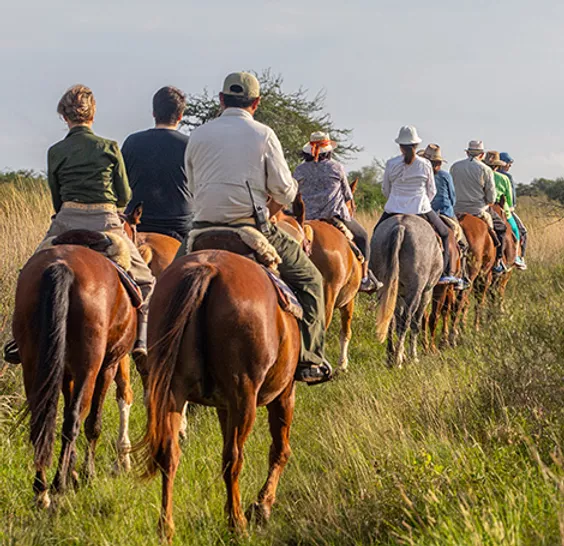
Corrientes is horse country and the wetland is best crossed on one. Options run from a short, gentle ride suitable for children and beginners to multi-day rides out of Carambola, which also offers the local speciality of swimming with the horses, and a canoe towed by a horse through the shallows, which is exactly as strange and good as it sounds.
Riding is available at Laguna Iberá, Carambola, Uguay, San Nicolás and Mburucuyá.
Walking, cycling and vehicle safaris
- Guided walks exist at nearly every portal and are how you see the grassland and woodland species that a boat never reaches.
- Cycling is a real option on the flat internal roads at Laguna Iberá, San Nicolás, Mburucuyá and the Cambyretá bike path, and wildlife tolerates a bicycle better than a vehicle.
- Vehicle safaris, in open 4x4s, cover ground fast in the grasslands. Cambyretá and San Antonio run them.
Birding and photography
Iberá is a world-class birding destination with more than 350 species recorded, and several of the world's rarest grassland birds. Dedicated birding outings run at every portal; Cambyretá, Galarza, Uguay and Mburucuyá are the specialists' choices. The field guide goes species by species.
Photographic safaris, run at a slower pace with light and position in mind rather than distance covered, are offered at Laguna Iberá, Carambola, San Antonio, Cambyretá and Mburucuyá. If you are carrying a long lens, book one of these rather than a standard excursion.
Fishing
Catch-and-release sport fishing for golden dorado, surubí and pacú, at the two portals where it is permitted: Río Corriente and Carambola. The season runs roughly September to March, with a closed season in November and December to protect spawning. Fly fishing is a Carambola speciality.
Dark skies
There is no light pollution here worth speaking of. Astro-tourism is a formal offering at Laguna Iberá and Carambola, and an informal one everywhere else: walk away from the buildings on a clear winter night and look up. May to August gives the clearest skies.
The human side
Easy to skip and worth not skipping.
- Artisan visits. Weavers, silversmiths and carvers at Laguna Iberá, San Antonio, San Nicolás, Uguay and Carambola.
- Cultural and historical circuits. Jesuit ruins near Galarza, the historical circuit at Río Corriente, colonial Loreto near San Antonio, and the chamamé museum and festival around Mburucuyá.
- Local food. Chipá, mbejú, surubí and the asado. Fifty-odd places to eat across the portals, concentrated at Pellegrini and Carambola.
Book the activity through your posada rather than shopping around online. Most lodgings either run their own outings or work with a specific guide, and the local phone call gets you a better slot and an honest answer about conditions than any booking form will.
Which portal for which activity
- Everything, most choice: Laguna Iberá (Carlos Pellegrini)
- Macaws, grassland birds, cycling, vehicle safaris: Cambyretá
- Horses, multi-day riding, fly fishing, dark skies: Carambola
- Canoe poling, dry Chaco species, cycling: San Nicolás
- Kayak, night walks, vehicle safaris, artisans: San Antonio
- Night navigation, undeveloped birding, Jesuit ruins: Galarza
- Community tourism, walking, artisans: Uguay
- The multi-day crossing, island camping: Capivari
- Sport fishing, river snorkelling, history: Río Corriente
- Birding, chamamé, palm groves, carriage rides: Mburucuyá
Frequently asked questions
What is there to do in the Iberá Wetlands?
Boat safaris, night safaris, kayaking, traditional canoe poling, horseback riding, guided walks, cycling, vehicle safaris, birding and photographic outings, catch-and-release fishing, astro-tourism and artisan and cultural visits. Availability varies by portal.
What is the best activity in Iberá?
The dawn or dusk boat safari, for sheer volume of wildlife at close range. The night safari is the one most people say they wish they had done twice.
Can you kayak in the Iberá Wetlands?
Yes, at Laguna Iberá, San Nicolás, San Antonio, Carambola and Capivari. Capivari is also the start of the Cruce de los Esteros, a three to five day crossing with island camping.
Is there fishing in Iberá?
Catch-and-release for golden dorado, surubí and pacú at the Río Corriente and Carambola portals, roughly September to March, with a closed season in November and December.
Do I need to book activities in advance?
For the standard boat safaris, usually not: your lodging will arrange them. For bird guides, photographic safaris and anything multi-day, yes, well ahead.
Are the activities suitable for children?
Many are. Boat safaris, short gentle rides and the shorter walks all work with children. The multi-day crossings and long rides do not.
Iberá Experience is the free guide app to the Ibera Wetlands. It shows you which of the ten gateway portals to choose, where to stay, and who runs the boat safaris, birding walks and transfers, with direct contact for each one. No sign-up, and it works straight from your browser. Start at iberaexperience.com.
Sources, last checked July 2026: activity availability by portal and operator distribution (Iberá Experience portal and provider database, recounted at time of writing); bird species total (Rewilding Argentina); dorado season and closed season (provincial fishing regulations). Activities and schedules change seasonally and with water levels: confirm with your lodging or guide before booking.
Start planning your Iberá trip
Free, no download and no sign-up: the app that gathers all 10 access portals and more than 400 local providers of the wetlands.
Open Iberá Experience