Colonia Carlos Pellegrini is the village on the shore of Laguna Iberá, at one of the wetland's ten gateway portals, and it has more places to stay than any other portal. This guide covers what a visitor from abroad needs to know before arriving: the park ticket, cash and fuel, what to do once you are there, where to sleep and how to get in.
A village of sand streets on the lagoon
Carlos Pellegrini is a small village in the General San Martín department of Corrientes province, in north-eastern Argentina, and it lies inside the Iberá Natural Reserve. The streets are sand and the village sits right on the lagoon. You arrive on provincial route 40, which crosses Laguna Iberá on a causeway completed in 1972, with a Bailey bridge over the middle of the lagoon. Before that, from 1912 onwards, the crossing was made on a raft pulled by oxen.
For a village this size there is a lot of choice: more places to stay than at any other portal, from campsites to boutique lodges. It also draws the crowds: according to a CAME report, it was the destination with the highest demand in the province during the July 2026 winter school holidays.
Two parks, one ticket
Two different protected areas meet at Pellegrini, and only one of them charges for entry:
- The Iberá Provincial Park charges an entry fee. The ticket is valid for five days of your stay and covers the public-use areas, including the trails that start at the interpretation centre. You buy it at the park entrance, which you reach as you arrive in the village from Mercedes, before you enter the village itself. Buy it before booking excursions. Foreign visitors pay a higher rate than Argentines, and the rate is set in pesos and revised, so check it on arrival.
- Iberá National Park has its own Laguna Iberá portal at the village entrance, and entry there is free.
Since May 2026 a wild jaguar has been turning up on the public trails at Pellegrini. Rangers track it every day and close the trails nearest to it, and at times the whole national park sector, until it moves on. Ask at the entrance which trails are open that day.
Cash, fuel and signal
- Money. Prices are in Argentine pesos. In August 2023 the village got a Banco de Corrientes ATM site; before that, residents had to travel 120 km each way for banking. Do not rely on it alone: arrive with enough pesos for your stay.
- Fuel. There is no service station in the village. Fill the tank in Mercedes.
- Signal. Mobile signal is weak or absent on long stretches of the gravel road, so tell your lodging when you set off.
What to do
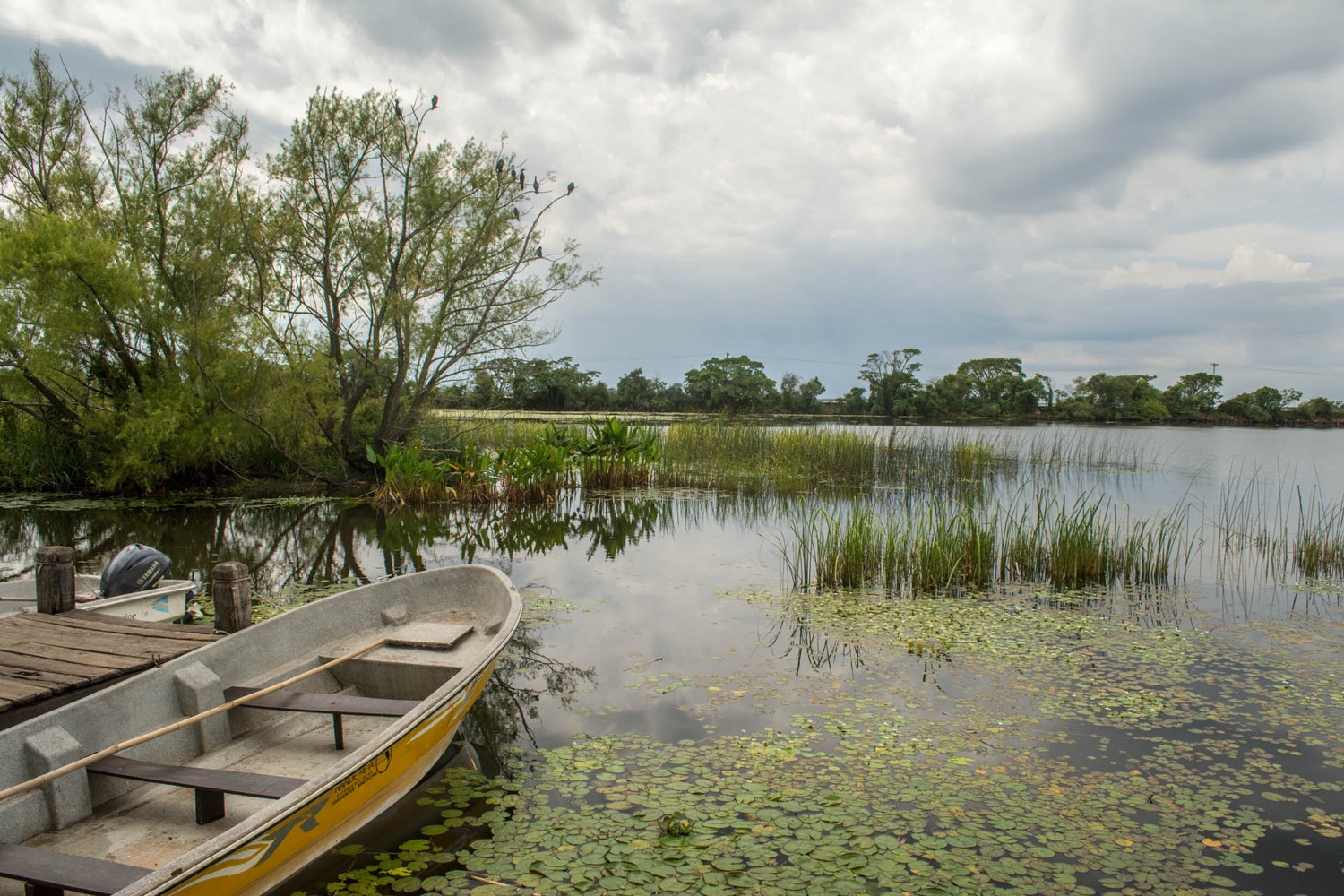
A boat outing on the lagoon
Licensed local guides take visitors out by boat on the lagoon, along the edge of the marsh and through the channels between floating vegetation. Among the species recorded at this portal:
- Caimans, both the broad-snouted caiman and the yacare caiman
- Capybaras, the largest living rodent, grazing along the shore
- Marsh deer, the largest deer in South America
- Roseate spoonbills, jabirus and many kinds of heron
- Coypus, and with luck a Neotropical otter
When to go out depends on the season. In summer, outings leave early to beat the heat. In winter, the national parks administration suggests the hours from mid-morning to afternoon, when the sun is strong and the animals come out to warm up. What a typical trip involves, and how long it lasts, is covered in what the boat safari is actually like.
The boardwalk and the monkey trail
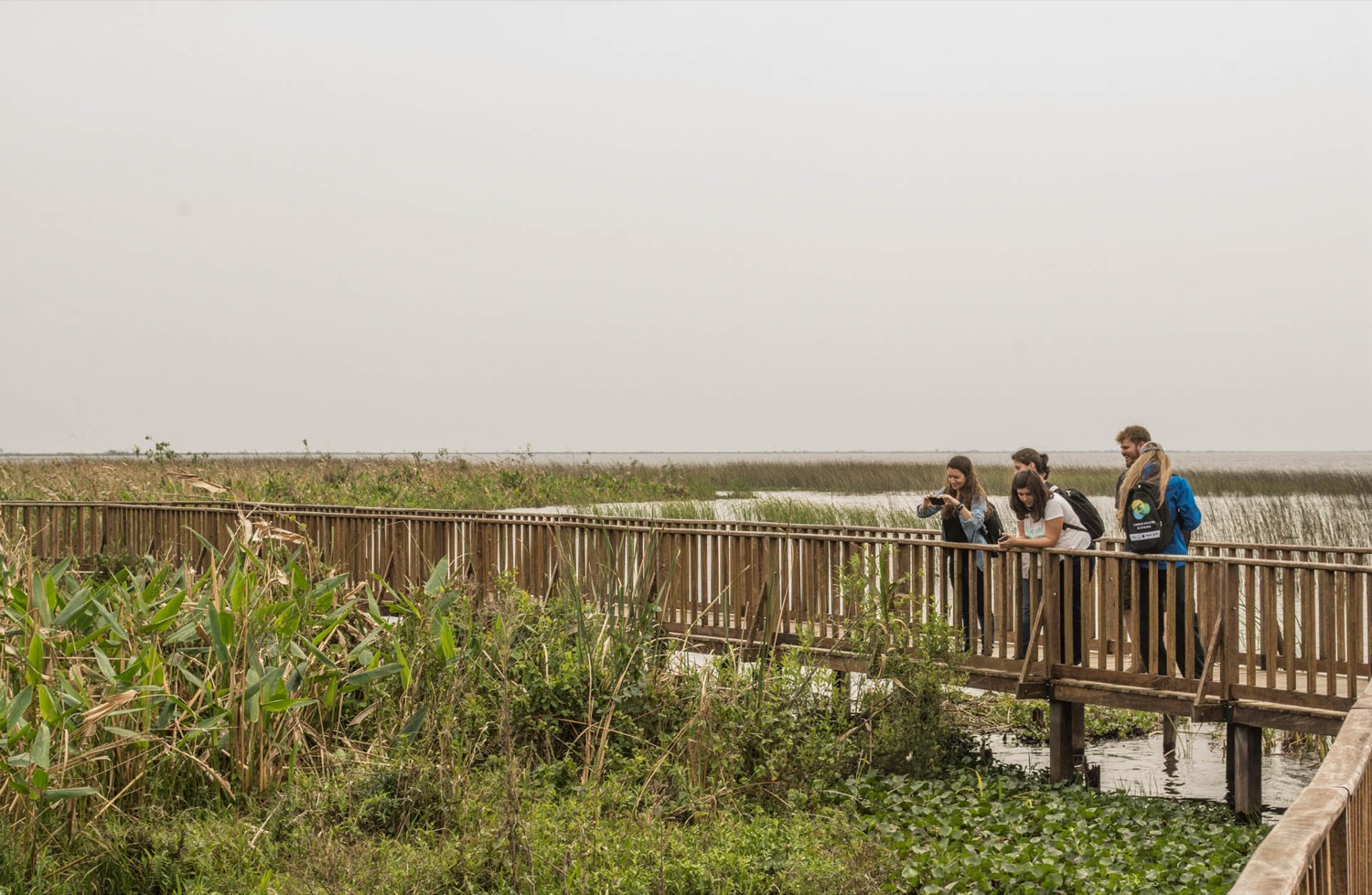
The provincial park's interpretation centre, at the entrance to the village, is the starting point for short trails that you can walk on your own or with a guide. One follows raised boardwalks out over the edge of the lagoon. Another, the Carayá trail, winds through a patch of gallery forest and is named after the black howler monkey (carayá): a family group has been reported living in that patch of forest. The dominant male's howl carries a long way, so you may hear them before you see them. These trails are inside the provincial park, so they are covered by the park ticket.
Kayak and canoe
Local operators run kayak outings on the lagoon, several of them based at the municipal campsite, and canoe trips are offered too. Without an engine you glide in quietly, at water level. Where and when to paddle is in the kayaking guide.
On horseback
Several local providers run horseback rides around the village and out into the countryside along the marsh, and at least one route crosses palm groves and giant anthills.
Night walks and dark skies
After dark the wetland changes. Night walks in the national park sector normally run only on Fridays, Saturdays, Sundays and holidays, booked with a licensed guide, but they were suspended in mid-2026 because of the jaguar using the trails, and at least one local operator now runs its night walk on a private reserve outside the park, so check when you book. Local operators also run night outings, including vehicle night safaris that can be booked at the municipal campsite, and some providers offer stargazing.
Buy the provincial park ticket on your first day and plan around it. It lasts five days, so a third morning on the water costs you nothing extra in entry, and the extra time gives you a spare day if rain cancels an outing.
Where to stay
Pellegrini has more lodging than any other portal in the Iberá:
- Guesthouses, posadas and B&Bs: from simple rooms to comfortable posadas, several of them family-run.
- Cabins and houses to rent: self-contained.
- Boutique lodges: the top of the range, some with meals and excursions included.
- Two campsites, one of them the municipal campsite on the lagoon shore.
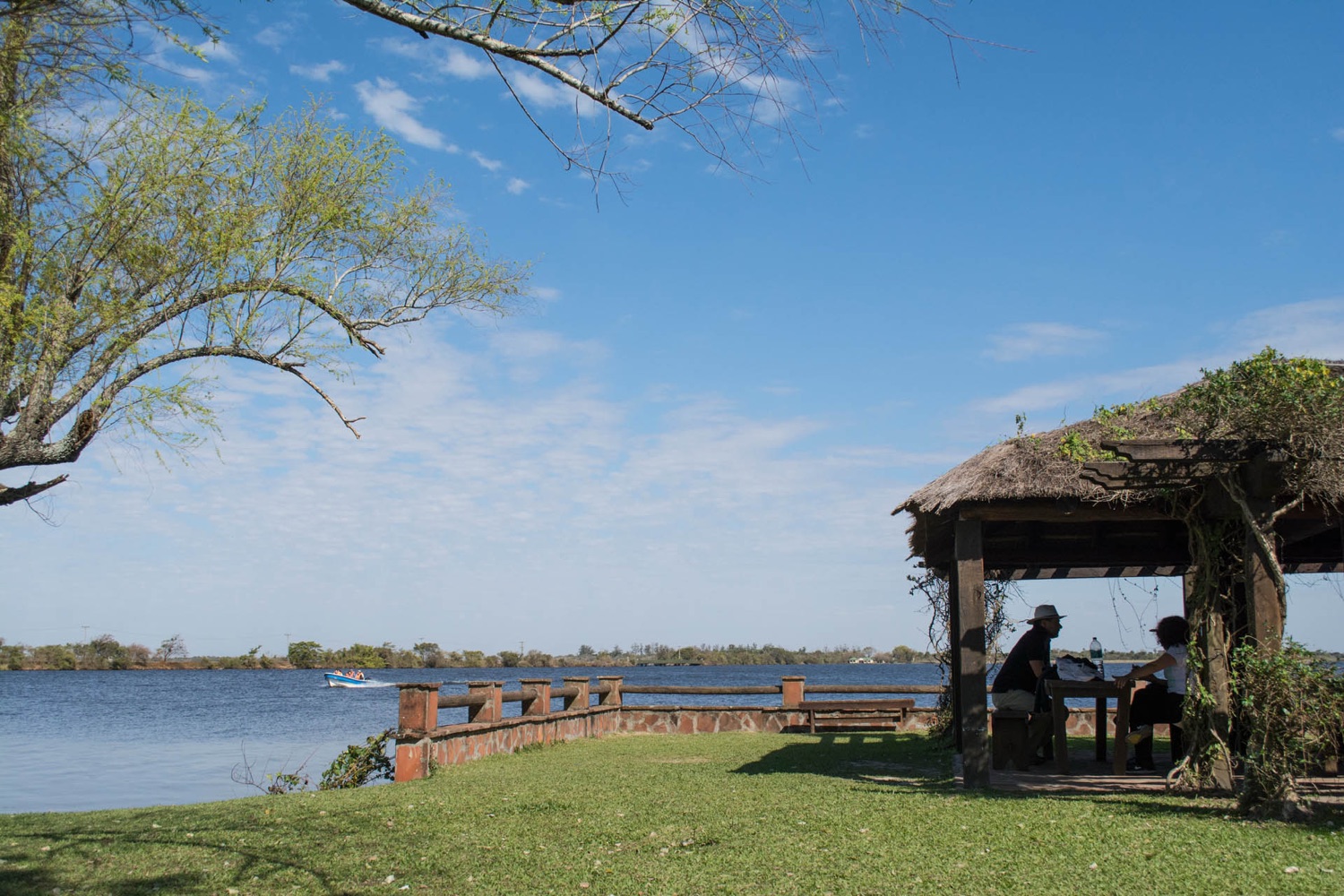
Most places are booked directly with the owner, usually by WhatsApp. Book well ahead for July, when Argentina's winter school holidays fall. Every lodging at the portal, with photos and direct contact, is on the Laguna Iberá portal page, and the comparison with the other portals is in where to stay, portal by portal.
When to go
You can visit all year, and each season has its trade-offs rather than a single right answer. The long-term climate normals from the INTA station in Mercedes give January highs of about 32 °C (90 °F), so in summer outings start early and pick up again in the afternoon. July averages highs of about 20 °C (68 °F), with nights around 9 °C (48 °F), and July and August are the driest months. Autumn and spring sit in between. July also brings the school-holiday crowds. The season-by-season detail is in when to visit.
Getting there
Carlos Pellegrini is about 120 km (75 miles) from Mercedes, the town you drive in from, and roughly 860 km (535 miles) from Buenos Aires by road, via national routes 14 and 119 to Mercedes and then provincial route 40.
The first 50 km or so (31 miles) out of Mercedes are paved. After that come some 70 km (43 miles) of gravel. Whether an ordinary car will do depends on recent rain: the national parks administration recommends a high-clearance vehicle or a 4x4 depending on the rainfall, and the provincial tourism ministry advises checking the state of the road before you travel. Drive it in daylight and allow more time than the distance suggests.
Without a car:
- Overnight bus to Mercedes. Long-distance buses to Mercedes leave Buenos Aires (Retiro) in the evening.
- Iberá Bus. A scheduled minibus leaves Mercedes around midday on Mondays, Wednesdays and Fridays and returns from Pellegrini on the same days before dawn. Sources give different departure times, so confirm it when you book.
- Private transfer. Local providers drive the Mercedes road, most of them in 4x4s. A few also come from further afield, from Posadas or from the city of Corrientes, and one of them picks up at Posadas airport.
Transfer providers for the portal are listed in Iberá Experience, and every route into the wetland is compared in the full guide to getting here.
Pellegrini and the other portals
Pellegrini has the most choice, but it is not the only way in. Portal Galarza, on the eastern side, has big lagoons and only a handful of providers. Portal San Antonio, in the north near Loreto, is a good base for kayaking and boat trips through quiet wetlands. All ten are compared in the portals guide.
Frequently asked questions
Is there an entry fee in Carlos Pellegrini?
Yes, for the Iberá Provincial Park, which includes the interpretation centre trails. The ticket is valid for five days and is bought at the park entrance as you arrive. The national park sector at the village entrance is free.
Is there an ATM or a petrol station?
There is a Banco de Corrientes ATM site, opened in August 2023, but bring enough Argentine pesos anyway. There is no service station: fill up in Mercedes before the gravel road.
Can I get to Carlos Pellegrini without a car?
Yes. Take a long-distance bus to Mercedes, then the Iberá Bus (Mondays, Wednesdays and Fridays) or a private transfer for the last 120 km.
How many nights should I stay?
Two nights is the minimum that works: a boat outing, the trails and one more activity. Three give you a spare morning for weather and time for a night outing. More in how many days to plan for.
When is it hardest to find a room?
In July, during Argentina's winter school holidays. During the 2026 winter school holidays Carlos Pellegrini was the most sought-after destination in Corrientes, according to CAME. Book lodging well ahead for those weeks.
Iberá Experience is the free guide app to the Ibera Wetlands. For Carlos Pellegrini it gathers the lodging, boat trips, guides, restaurants and transfers of the portal in one place, with photos and direct contact by WhatsApp. No sign-up, and it works straight from your browser. Start at iberaexperience.com.
Sources, last checked October 2026: access from Mercedes, vehicle advice, the Iberá Bus days and times (which differ from the Cámara de Turismo's), free national park entry, national park night walk days and the best hours for wildlife in each season (Administración de Parques Nacionales, argentina.gob.ar/parquesnacionales/nea/parque-nacional-ibera); paved and gravel stretches of route 40 (Corrientes Ministry of Tourism, corrientes.tur.ar; El Litoral, 18 Jan 2024); the route from Buenos Aires, long-distance buses and the lack of fuel and mobile signal (Cámara de Turismo de los Esteros del Iberá; Omnilíneas bus timetables; Magia en el Camino, Sep 2019; Boleto a la Felicidad, Jun 2023); provincial park ticket and its five-day validity, trails, boardwalks, night walks with a licensed guide, campsites, activities and checking the road (Corrientes Ministry of Tourism, corrientes.tur.ar; Carlos Pellegrini municipality, via Iberá Experience); Carayá trail and its howler monkeys (La Capital, 23 Apr 2017); the jaguar on the trails, the trail closures and the suspended night walks (La Nación, 25 Jun and 24 Jul 2026; Meteored, 21 Jul 2026; a local guide, via Iberá Experience, Sep 2026); causeway, bridge, sand streets and village history (Corrientes provincial government); ATM site (El Litoral, 26 Aug 2023; Radio Dos, 27 Aug 2023; Banco de Corrientes ATM list); winter 2026 demand (CAME, via El Litoral, 3 Aug 2026); winter school holiday dates (Infobae, "Vacaciones de invierno 2026: cuándo terminan, provincia por provincia", 13 Jul 2026); climate normals for Mercedes (INTA EEA Mercedes); marsh deer and capybara (SIB); caiman species (La Nación); species recorded at the portal, lodging types, kayak operators at the municipal campsite, canoe, horseback, stargazing and transfer providers, and the lodging comparison between portals (Iberá Experience, October 2026). Fees, timetables and road conditions change: confirm locally before travelling. Cover photo: Rafael Abuín.
Start planning your Iberá trip
Free and no sign-up, on the web and on Google Play: the app that gathers all 10 access portals and more than 500 local providers of the wetlands.
Open Iberá Experience