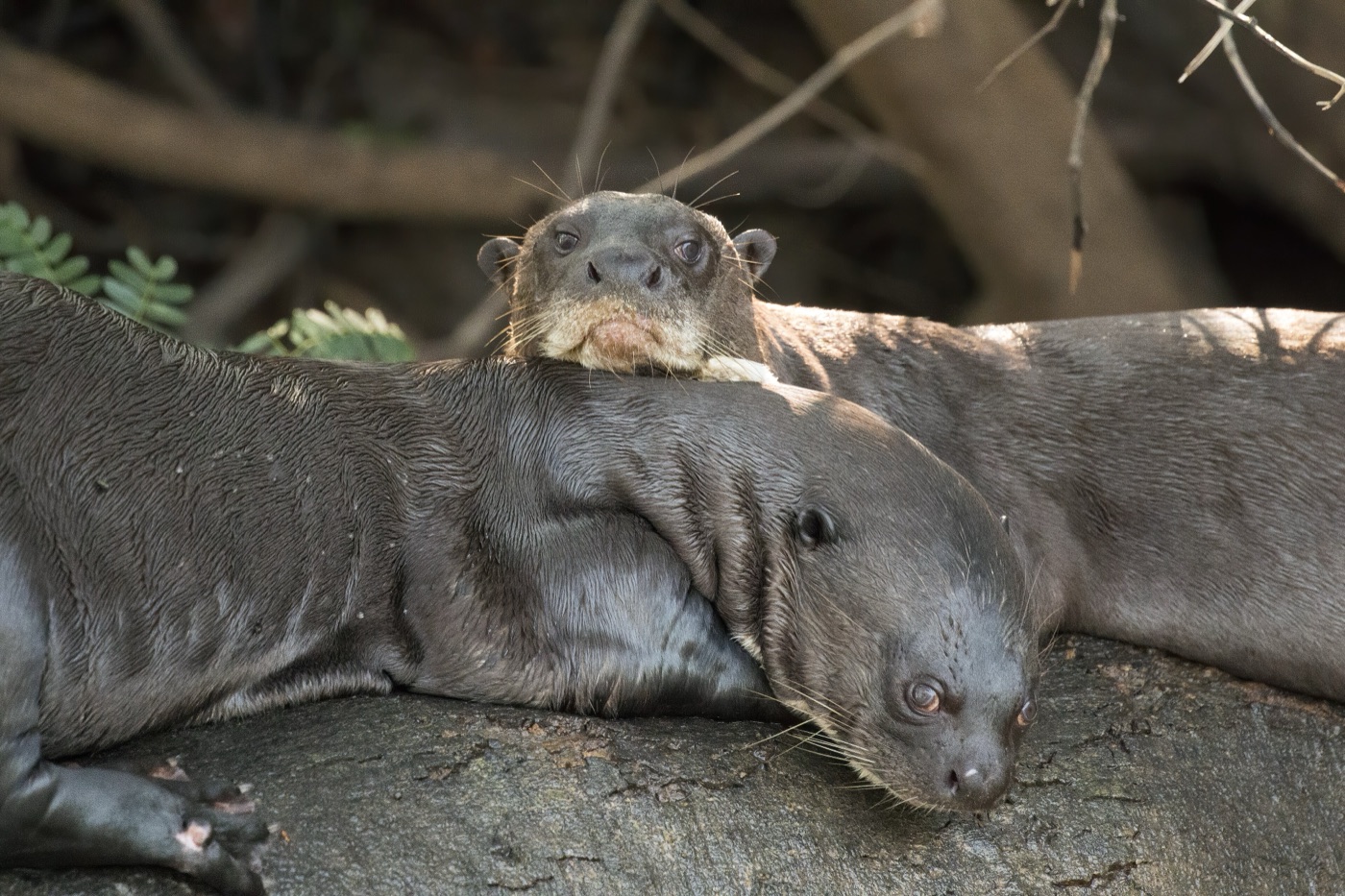
Absent from the country for almost 40 years (the last family groups were seen in 1986, after decades of hunting for its pelt), this giant returned on June 30, 2025, when Rewilding Argentina released the first family, a pair with two cubs, in Iberá. Extremely social, noisy and territorial: they live in cohesive family groups. Each individual has a unique pattern of white markings on the throat that works as a fingerprint for its identification at a distance. Considered Extinct at the national level (SAREM) until its reintroduction in Iberá; Endangered globally (IUCN), and now in full recovery. Total length: 1.50 to 1.80 m. Weight: 22 to 34 kg.
Behaviour
Highly cooperative: they hunt in coordinated family groups, surrounding and cornering their prey. A strict carnivorous diet: large quantities of fish (wolf fish, piranhas, catfish), eels and occasionally small caimans. They possess an enormous vocal repertoire that includes hisses, snorts and howls to coordinate the group.
How and when to see it
For now it is not something you will see on a regular outing. The first family, released in 2025, lives on San Alonso island, in the heart of the wetlands and far from the portals, and still moves around close to the project’s enclosures, where the Rewilding Argentina team monitors it.
Species profile
- Common nameGiant Otter
- Scientific namePteronura brasiliensis
- GroupMammal
- StatusReintroduced
- ConservationExtinct in Argentina (national conservation status: SAREM, 2025). It is back in the Iberá thanks to the reintroduction.
Conservation: national status published by the SIB (Argentine National Parks).
Other species of the Iberá
Discover all the wildlife of the Iberá
More than 250 species with photos, profiles and the gateways where you can see them. Map, providers and trip planner. Free, on the web and on Google Play.
Open Iberá Experience