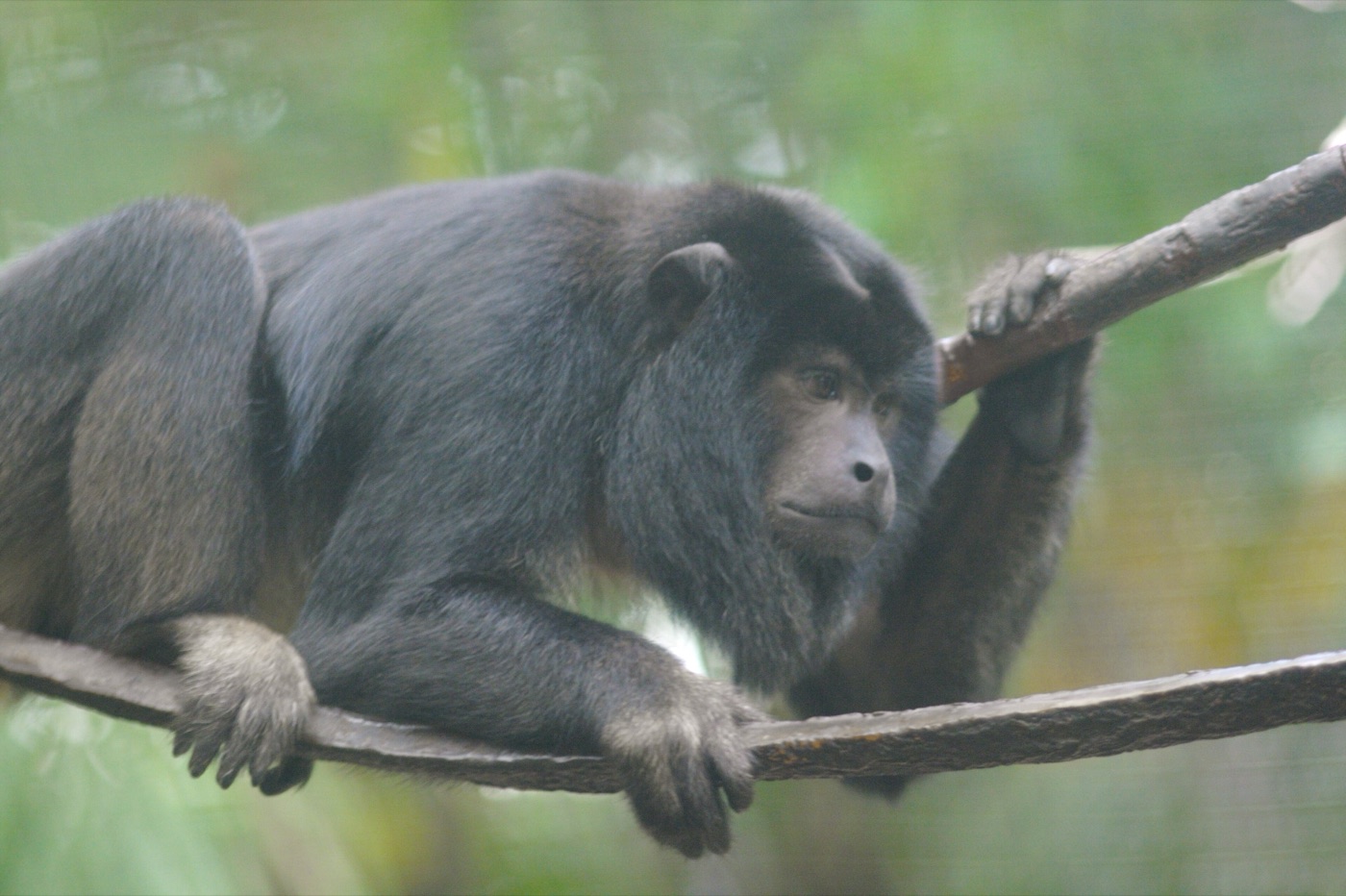
Marked sexual dimorphism: adult males are entirely black, while females and juveniles have golden-yellow fur. They live in family groups in the crowns of the tallest trees, and their synchronized roar at dawn, used to mark territory, is one of the most awe-inspiring sounds of Iberá. Vulnerable nationally, highly sensitive to the loss of native forest and to yellow fever outbreaks. Body length: 50 to 65 cm plus a prehensile tail of another 60 cm. Weight: males 5 to 8 kg, females 4 to 6 kg.
Behaviour
Strictly arboreal and diurnal; rarely comes down to the ground. Prehensile tail with a bare, rough patch of skin at the tip that works as a fifth limb. Slow metabolism: a folivorous and frugivorous diet of tender leaves, shoots, flowers and the fruit of higuerón, laurel and ambay. Alternates feeding bouts with long naps in the high branches.
How and when to see it
All day. Easily located by paying attention to its powerful howls at dawn and dusk, which carry for more than 1.5 km.
Where to see it in the Iberá
The gateways of the Great Iberá Park where black howler monkey has confirmed presence:
Tours to see it
Verified providers operating at the gateways where black howler monkey lives. You contact them directly on WhatsApp from the app.
- Esteros Ñe’é
Experiences with local storytelling and a cultural take on the marshes.★ 5.0 - Gaucho Argentino
Horseback journeys across a network of refuges in Iberá. Multi-day rides with overnight…★ 5.0 - Jurassic Plant - Night Tour
The only carnivorous-plant garden in Argentina and a pioneer in Latin America. A guided…★ 5.0 - Irupé Excursiones
Guided hiking. Guided visit to museums, historic sites, chapels and trails of the town…★ 5.0
Species profile
- Common nameBlack Howler Monkey
- Scientific nameAlouatta caraya
- GroupMammal
- StatusNative
Other species of the Iberá
Discover all the wildlife of the Iberá
More than 250 species with photos, profiles and the gateways where you can see them. Map, providers and trip planner. Free, no download needed.
Open Iberá Experience