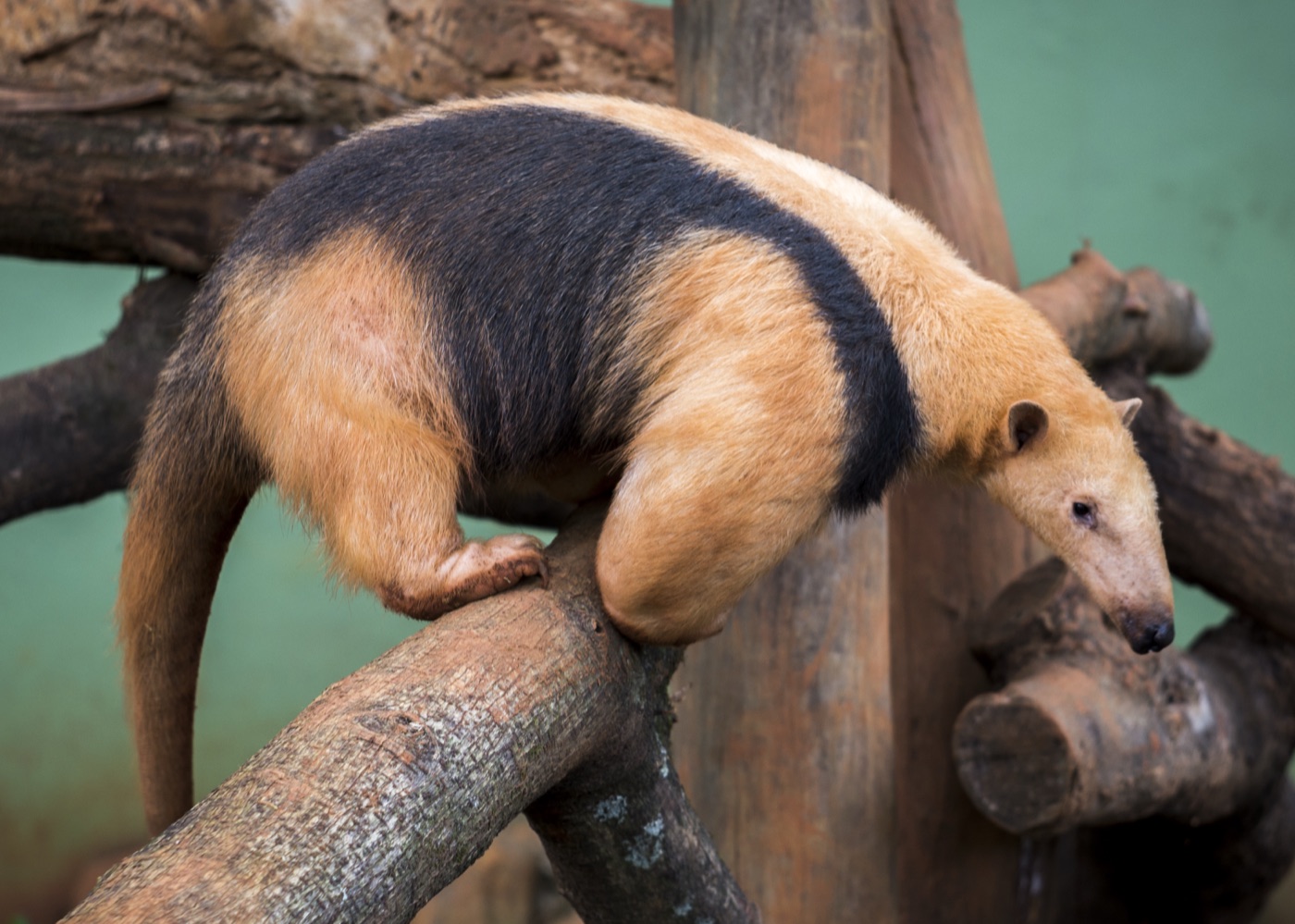
One of the most exotic and beautiful animals of Iberá. Its short, cream-yellow coat is marked by a jet-black "vest" covering its sides and back, making it unmistakable. Its long, curved snout has no teeth, and its extensible, sticky tongue of almost 40 cm lets it capture thousands of insects in seconds without destroying the colony, so it can return. Its front claws are enormous: it uses them both to break open ant nests and to hang from branches alongside its prehensile tail, which acts as a fifth limb. Total length: 90 to 130 cm (the tail accounts for almost 50%). Weight: 4.5 to 7 kg.
Behaviour
Solitary, both arboreal and terrestrial. It spends much of the day climbing native trees in search of arboreal ant and termite nests. If threatened on the ground, it stands up on its hind legs, spreads its arms in a "hugging" posture and shows its claws in defense. This intimidating gesture is so powerful that it can drive off dogs and pumas.
How and when to see it
Year round. Sightings are magical, chance events: slowly crossing an internal track in mid-morning or resting curled into a ball of fur in the fork of a tree. Portals Laguna Iberá and San Nicolás are the most productive.
Where to see it in the Iberá
The gateways of the Great Iberá Park where southern tamandua has confirmed presence:
Tours to see it
Verified providers operating at the gateways where southern tamandua lives. You contact them directly on WhatsApp from the app.
- Esteros Ñe’é
Experiences with local storytelling and a cultural take on the marshes.★ 5.0 - Gaucho Argentino
Horseback journeys across a network of refuges in Iberá. Multi-day rides with overnight…★ 5.0 - Irupé Excursiones
Guided hiking. Guided visit to museums, historic sites, chapels and trails of the town…★ 5.0 - Navegando Ituzaingó
Private sailboat rides on the Paraná with captain Mario: sunrise, morning and sunset…★ 5.0
Species profile
- Common nameSouthern Tamandua
- Scientific nameTamandua tetradactyla
- GroupMammal
- StatusNative
Other species of the Iberá
Discover all the wildlife of the Iberá
More than 250 species with photos, profiles and the gateways where you can see them. Map, providers and trip planner. Free, no download needed.
Open Iberá Experience