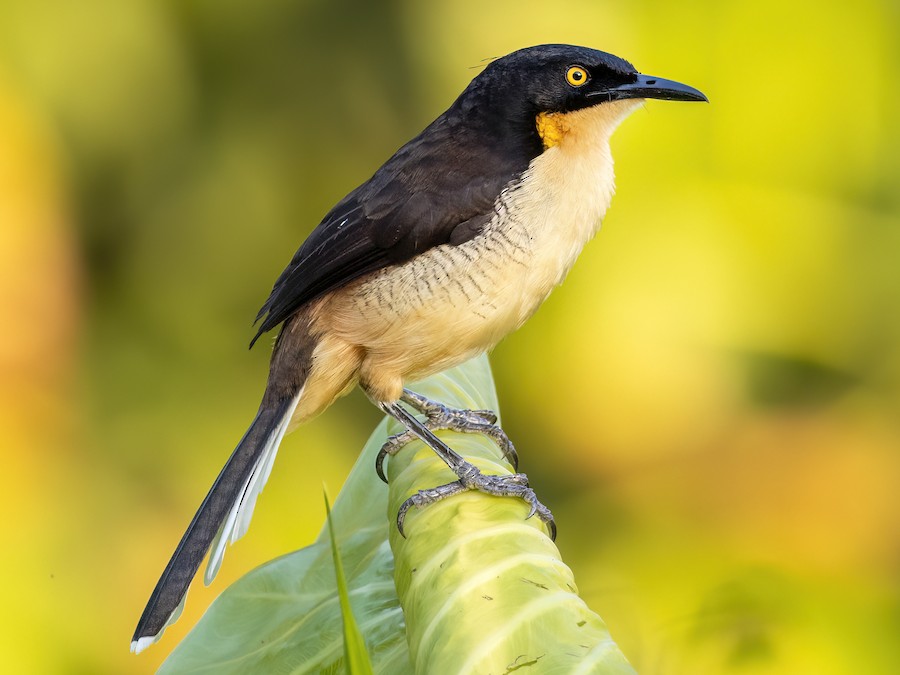
The donacobius belongs to its own unique family (Donacobiidae), with no known close relatives. Its appearance recalls a robust thrush: dark brown back, pale yellowish-cream breast and belly, a white stripe above the eye and intense, penetrating yellow eyes. The tail is long, graduated and white-tipped. They live and move always in pairs, never alone. Total length: 21 to 23 cm.
Behaviour
An insectivore that searches for ants, larvae, spiders and beetles among the tangle of water hyacinths and marsh vegetation. Its social behavior is a spectacle: on detecting an intruder, the pair climbs onto an exposed branch, stretches the neck, opens the wings and launches a powerful, rhythmic "angú-angú-angú" while both sway the tail in perfect synchrony, as if performing a rehearsed choreography.
How and when to see it
Year-round. Its powerful, unmistakable song announces its presence hundreds of meters before you see it. Any channel with dense vegetation guarantees the encounter.
Where to see it in the Iberá
The gateways of the Great Iberá Park where black-capped donacobius has confirmed presence:
Tours to see it
Verified providers operating at the gateways where black-capped donacobius lives. You contact them directly on WhatsApp from the app.
- Esteros Ñe’é
Experiences with local storytelling and a cultural take on the marshes.★ 5.0 - Gaucho Argentino
Horseback journeys across a network of refuges in Iberá. Multi-day rides with overnight…★ 5.0 - Irupé Excursiones
Guided hiking. Guided visit to museums, historic sites, chapels and trails of the town…★ 5.0 - Reserva Estero Camba Trapo
Private nature reserve of Ecoposada del Estero, on the Camba Trapo road. One of the…★ 5.0
Species profile
- Common nameBlack-capped Donacobius
- Scientific nameDonacobius atricapilla
- GroupBird
- StatusNative
Other species of the Iberá
Discover all the wildlife of the Iberá
More than 250 species with photos, profiles and the gateways where you can see them. Map, providers and trip planner. Free, no download needed.
Open Iberá Experience