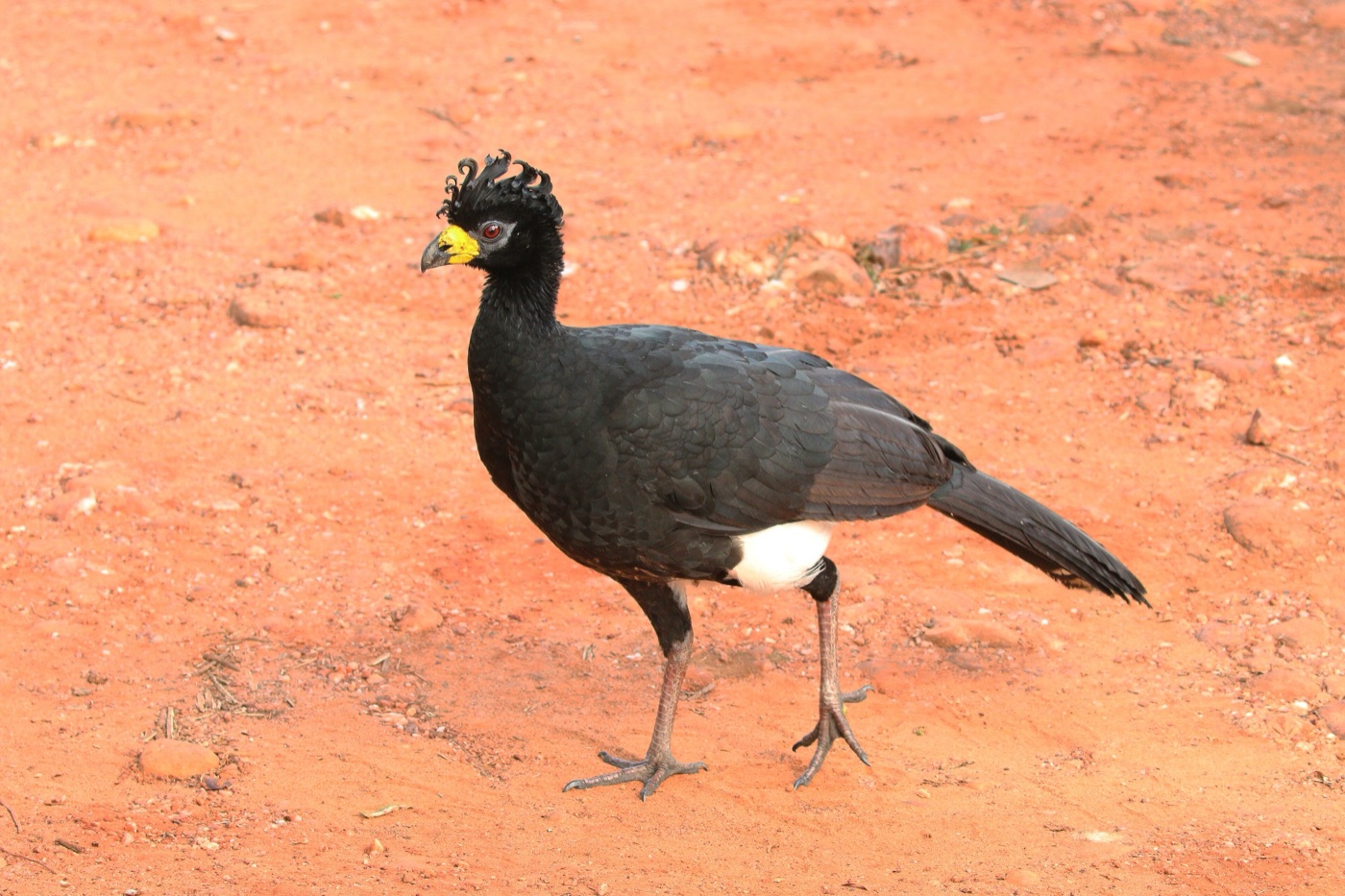
After spending nearly half a century extinct in the province of Corrientes due to poaching and habitat loss, the curassow returned to Iberá thanks to a successful reintroduction program. Marked sexual dimorphism: the male is jet-black with a white belly and a striking yellow protuberance on the bill; the female displays a heavily streaked, marbled plumage that allows it to camouflage among the branches. Both share a crest of curly feathers. Endangered at the national level (Vulnerable globally). Length: 75 to 85 cm. Weight: 2.5 to 4 kg.
Behaviour
Mainly diurnal: it walks along the woodland floor in search of food and climbs to the treetops to roost or sing. A frugivorous and granivorous diet: fallen fruit, seeds, leaves and insects. It plays the role of "gardener of the forest", dispersing native seeds. The males give a low, humming, low-frequency song that resonates across the forest floor.
How and when to see it
Year-round in the patches of native woodland. The first hours of the morning, when they come down from the trees to feed.
Where to see it in the Iberá
The gateways of the Great Iberá Park where bare-faced curassow has confirmed presence:
Tours to see it
Verified providers operating at the gateways where bare-faced curassow lives. You contact them directly on WhatsApp from the app.
- Navegando Ituzaingó
Private sailboat rides on the Paraná with captain Mario: sunrise, morning and sunset…★ 5.0 - Reserva Natural Don Luis
Private nature reserve in the Cambyretá portal, run by the Fundación Cambyretá. Guided…★ 4.9 - J&J Excursiones de Pesca
Sport fishing outings on the Paraná with licensed guide José Luis Hintz. They also run…★ 4.9 - Iberá Connecta
Tailor-made excursions from Ituzaingó to the Cambyretá, San Antonio, San Nicolás and…★ 4.7
Species profile
- Common nameBare-faced Curassow
- Scientific nameCrax fasciolata
- GroupBird
- StatusReintroduced
Other species of the Iberá
Discover all the wildlife of the Iberá
More than 250 species with photos, profiles and the gateways where you can see them. Map, providers and trip planner. Free, no download needed.
Open Iberá Experience