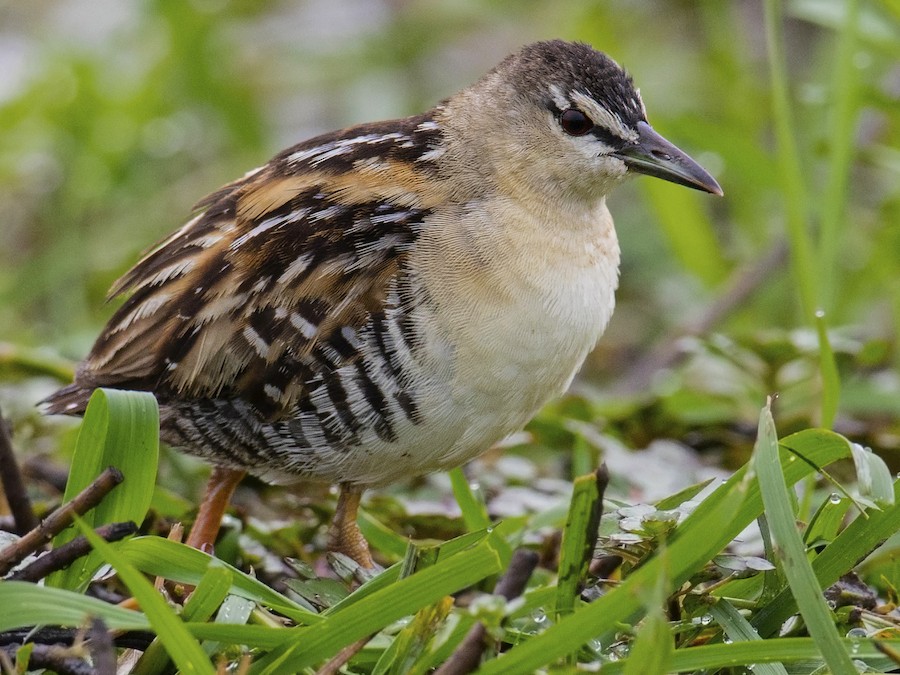
A tiny rail of just 12.5 to 14 cm. The plumage has a dark brown back with black bars, a dark crown with a marked white eyebrow and a black eye-line, a white throat, a buff-yellow breast and upper belly, and flanks barred in black and white. The legs are yellowish. The bill is short. It inhabits waterlogged grasslands, low reedbeds and marsh edges with dense herbaceous vegetation. One of the smallest and most elusive rails on the continent.
Behaviour
It walks extremely fast through the low vegetation at ground level, almost never flying and very rarely crossing open spaces. An insectivore and granivore of micro-habitats: the seeds of aquatic grasses and small invertebrates of the damp ground.
How and when to see it
Practically invisible under normal conditions. It is detected mostly at dawn by listening for its call, a fast, rhythmic trill, in waterlogged grasslands such as those of Portal Capivari and Laguna Iberá.
Where to see it in the Iberá
The gateways of the Great Iberá Park where yellow-breasted crake has confirmed presence:
Tours to see it
Verified providers operating at the gateways where yellow-breasted crake lives. You contact them directly on WhatsApp from the app.
- Esteros Ñe’é
Experiences with local storytelling and a cultural take on the marshes.★ 5.0 - Reserva Estero Camba Trapo
Private nature reserve of Ecoposada del Estero, on the Camba Trapo road. One of the…★ 5.0 - Cabalgata Cintia
Horseback rides around Carlos Pellegrini.★ 5.0 - Iberá Spirit
Travel agency specializing in the Esteros del Iberá for 10 years. Packages, excursions…★ 5.0
Species profile
- Common nameYellow-breasted Crake
- Scientific nameLaterallus flaviventer
- GroupBird
- StatusNative
Other species of the Iberá
Discover all the wildlife of the Iberá
More than 250 species with photos, profiles and the gateways where you can see them. Map, providers and trip planner. Free, no download needed.
Open Iberá Experience