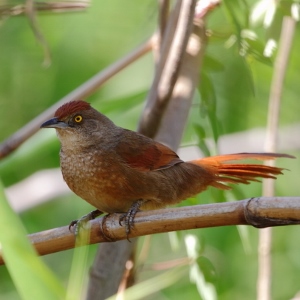
A furnariid, 19 to 22 cm, the most robust of the spinetails. It is rufous on the crown, wings and tail, with a more olive back and whitish throat, breast and belly. The yellow iris is distinctive. The bill is medium-sized. It inhabits the riverside trees of the gallery forest, especially near water, where it builds its stick nests. Its distribution is tied to the rivers and streams of northeastern Argentina.
Behaviour
It lives in pairs or small groups. It builds large conical stick nests that hang from the branches of riverside trees, often over the water. The nests are complex and have a side entrance with a tube. The song is a rapid series of metallic "ki-ki-ki-ki" notes. It feeds on insects and larvae among the branches.
How and when to see it
Year round along the banks of the gallery forest. The nests over the water are very conspicuous and easy to see. Portal Laguna Iberá and Galarza.
Where to see it in the Iberá
The gateways of the Great Iberá Park where greater thornbird has confirmed presence:
Tours to see it
Verified providers operating at the gateways where greater thornbird lives. You contact them directly on WhatsApp from the app.
- Esteros Ñe’é
Experiences with local storytelling and a cultural take on the marshes.★ 5.0 - Gaucho Argentino
Horseback journeys across a network of refuges in Iberá. Multi-day rides with overnight…★ 5.0 - Irupé Excursiones
Guided hiking. Guided visit to museums, historic sites, chapels and trails of the town…★ 5.0 - Reserva Estero Camba Trapo
Private nature reserve of Ecoposada del Estero, on the Camba Trapo road. One of the…★ 5.0
Species profile
- Common nameGreater Thornbird
- Scientific namePhacellodomus ruber
- GroupBird
- StatusNative
Other species of the Iberá
Discover all the wildlife of the Iberá
More than 250 species with photos, profiles and the gateways where you can see them. Map, providers and trip planner. Free, no download needed.
Open Iberá Experience