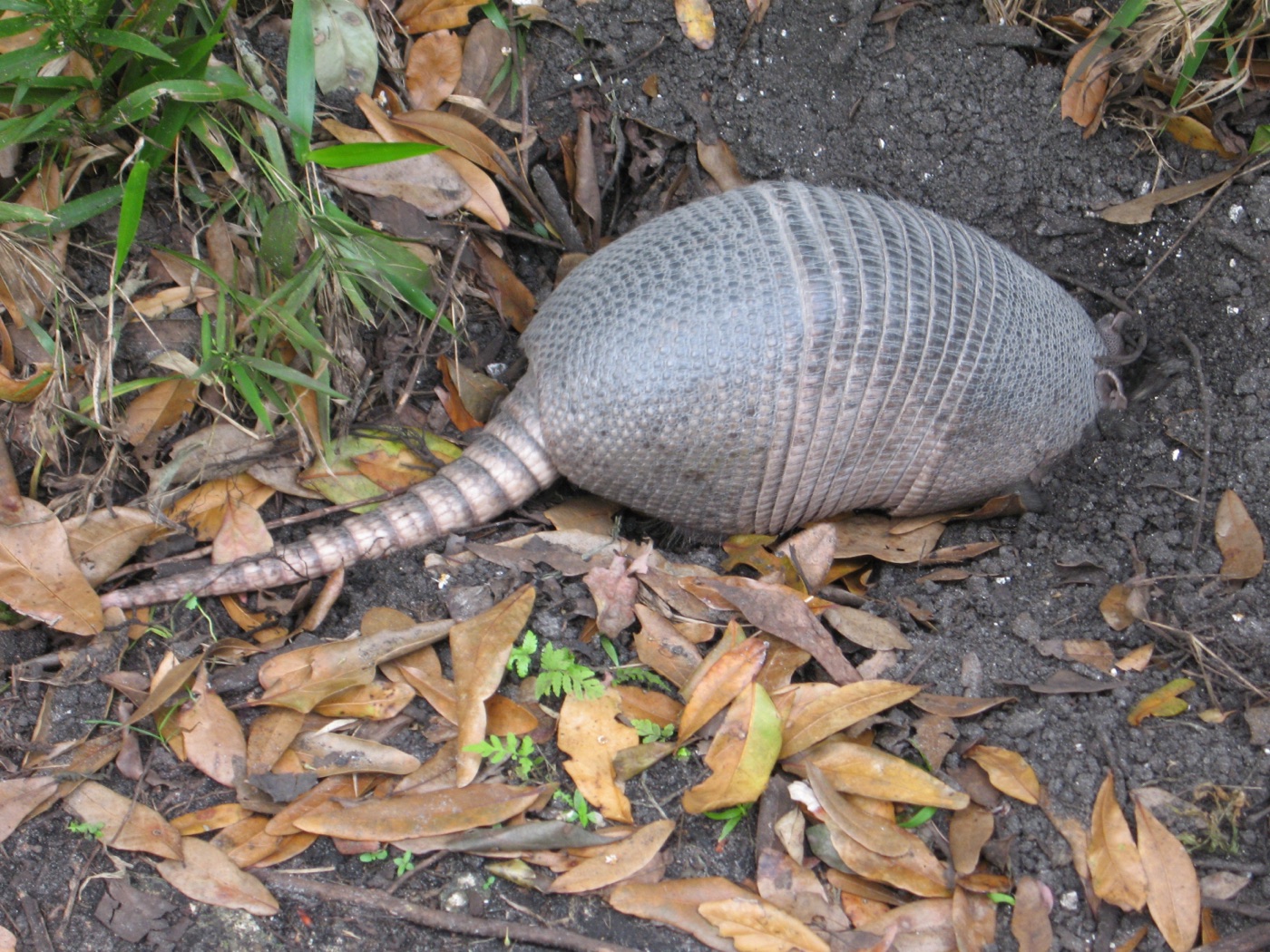
Also known as mulita grande in the Litoral region. Its arched, grayish to brown shell has strictly between 9 and 10 movable bands in the center of the armor. Its head is elongated with separated ears and its tail is very long. It shares with the other armadillos of the genus Dasypus a rarity no other vertebrate has: females always give birth to identical young from a single fertilized egg (monozygotic polyembryony), quadruplets in the case of this species. Total length: 65 to 80 cm. Weight: 3.5 to 6 kg.
Behaviour
Crepuscular and nocturnal, though on mild winter days it can be seen active in mid-afternoon. It walks noisily through the grassland, detecting food by smell. It eats ants, beetles, spiders, small amphibians and fallen fruit. When startled, it makes a surprising vertical leap into the air before running to the nearest burrow.
How and when to see it
Year round. Very common along the edges of vehicle tracks on dry ground or around the camping areas at sundown. Present at all the park's portals.
Where to see it in the Iberá
The gateways of the Great Iberá Park where nine-banded armadillo has confirmed presence:
Tours to see it
Verified providers operating at the gateways where nine-banded armadillo lives. You contact them directly on WhatsApp from the app.
- Esteros Ñe’é
Experiences with local storytelling and a cultural take on the marshes.★ 5.0 - Gaucho Argentino
Horseback journeys across a network of refuges in Iberá. Multi-day rides with overnight…★ 5.0 - Irupé Excursiones
Guided hiking. Guided visit to museums, historic sites, chapels and trails of the town…★ 5.0 - Navegando Ituzaingó
Private sailboat rides on the Paraná with captain Mario: sunrise, morning and sunset…★ 5.0
Species profile
- Common nameNine-banded Armadillo
- Scientific nameDasypus novemcinctus
- GroupMammal
- StatusNative
Other species of the Iberá
Discover all the wildlife of the Iberá
More than 250 species with photos, profiles and the gateways where you can see them. Map, providers and trip planner. Free, no download needed.
Open Iberá Experience