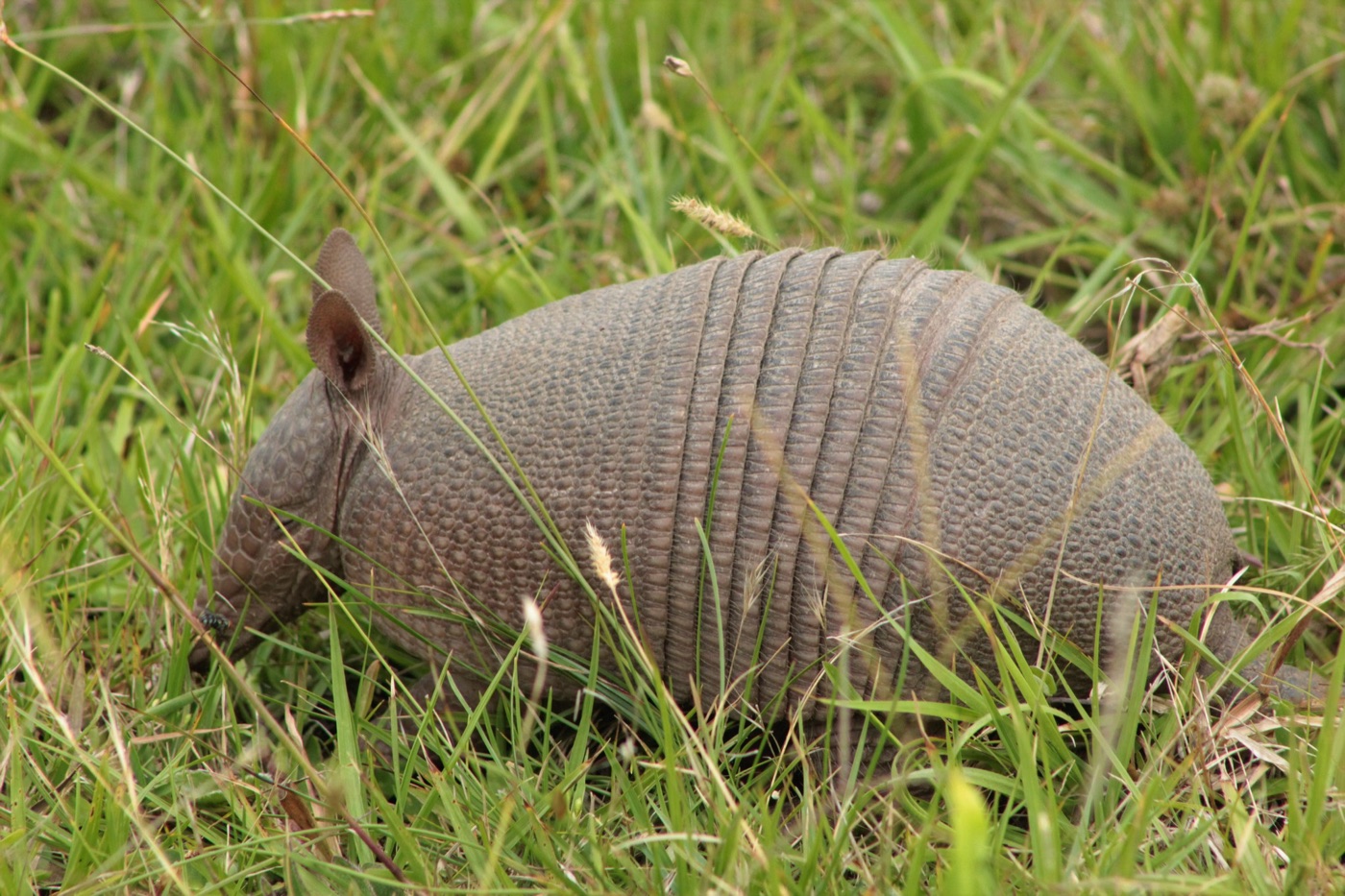
The smallest and most compact of the long-nosed armadillos of Iberá. Its shell is markedly globular, rounded and pale grayish in color, with 6 to 7 movable bands. Its snout is shorter and flatter than that of its larger relatives, and its ears are small and well separated. Unlike other long-nosed armadillos, it prefers the open habitats of pure grasslands and dry savannas, avoiding dense woodland. Total length: 40 to 50 cm (with a proportionally short tail). Weight: 1.5 to 2.5 kg.
Behaviour
Mostly diurnal and crepuscular, adjusting its schedule to avoid extreme cold or stifling heat. A fast digger that builds burrows with perfectly circular openings in sandy soils. It eats ground insects, ants, crickets and tender roots. Skittish: it quickly blends into the clumps of grass.
How and when to see it
Year round, with the best chances on sunny spring and autumn afternoons. The attentive visitor may spot it moving through the tall grass beside the trails. Portal Mburucuyá is the best place in the park to record the species.
Where to see it in the Iberá
The gateways of the Great Iberá Park where seven-banded armadillo has confirmed presence:
Tours to see it
Verified providers operating at the gateways where seven-banded armadillo lives. You contact them directly on WhatsApp from the app.
- Navegando Ituzaingó
Private sailboat rides on the Paraná with captain Mario: sunrise, morning and sunset…★ 5.0 - Excursiones Yetapá (Eduardo Alegre)
Excursions in the Iberá based in San Miguel, run by licensed guide Eduardo (Gualo)…★ 5.0 - La Tata en Yvera
Excursions and sport fishing in the Iberá Wetlands, based in San Miguel, the access town…★ 4.9 - Reserva Natural Don Luis
Private nature reserve in the Cambyretá portal, run by the Fundación Cambyretá. Guided…★ 4.9
Species profile
- Common nameSeven-banded Armadillo
- Scientific nameDasypus septemcinctus
- GroupMammal
- StatusNative
Other species of the Iberá
Discover all the wildlife of the Iberá
More than 250 species with photos, profiles and the gateways where you can see them. Map, providers and trip planner. Free, no download needed.
Open Iberá Experience