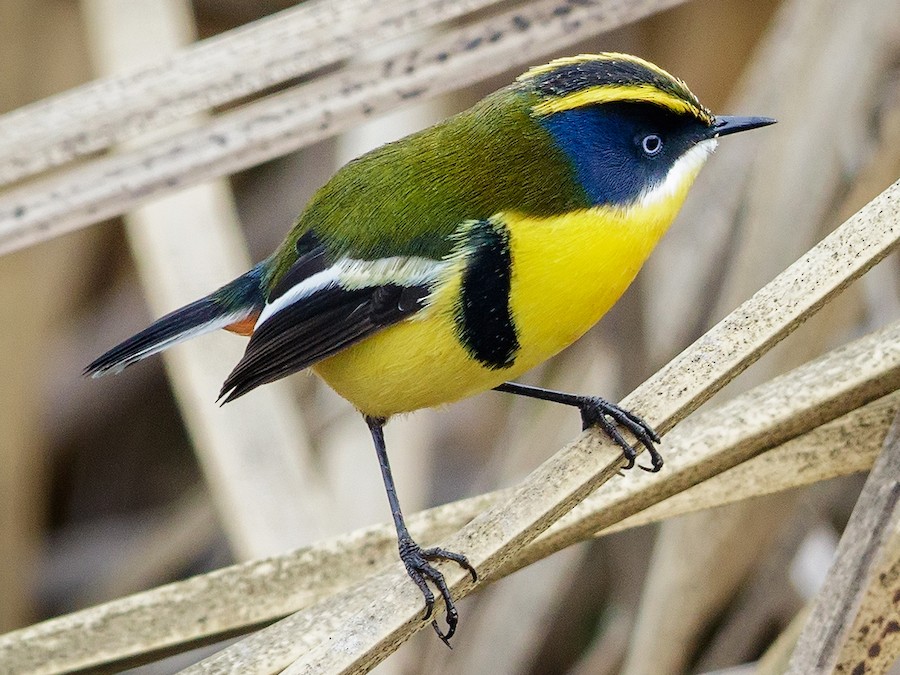
The smallest and most colorful of the reedbed birds of the Iberá: barely 11 cm. The male's plumage combines a red crown, a blue face, an olive-green back, black-and-white wings, a yellow breast, a white belly and a red undertail, hence its Spanish name ("seven colors"). The female has duller colors but the same pattern. It inhabits exclusively the dense cattail and rush beds where permanent water is the constant. One of the most sought-after birds by the birders of the Iberá.
Behaviour
Very active and agile. It moves among the cattail stems and rushes low over the water with great agility, chasing aquatic insects and spiders. The male sings from the tip of the rushes with a thin, repeated call. It builds a cup-shaped nest woven between the cattail stems.
How and when to see it
Year-round. The cattail stands of Portal Laguna Iberá are famous among ornithologists for the abundance of this species. It can be seen easily on kayak excursions.
Where to see it in the Iberá
The gateways of the Great Iberá Park where many-colored rush tyrant has confirmed presence:
Tours to see it
Verified providers operating at the gateways where many-colored rush tyrant lives. You contact them directly on WhatsApp from the app.
- Esteros Ñe’é
Experiences with local storytelling and a cultural take on the marshes.★ 5.0 - Reserva Estero Camba Trapo
Private nature reserve of Ecoposada del Estero, on the Camba Trapo road. One of the…★ 5.0 - Cabalgata Cintia
Horseback rides around Carlos Pellegrini.★ 5.0 - Iberá Spirit
Travel agency specializing in the Esteros del Iberá for 10 years. Packages, excursions…★ 5.0
Species profile
- Common nameMany-colored Rush Tyrant
- Scientific nameTachuris rubrigastra
- GroupBird
- StatusNative
Other species of the Iberá
Discover all the wildlife of the Iberá
More than 250 species with photos, profiles and the gateways where you can see them. Map, providers and trip planner. Free, no download needed.
Open Iberá Experience