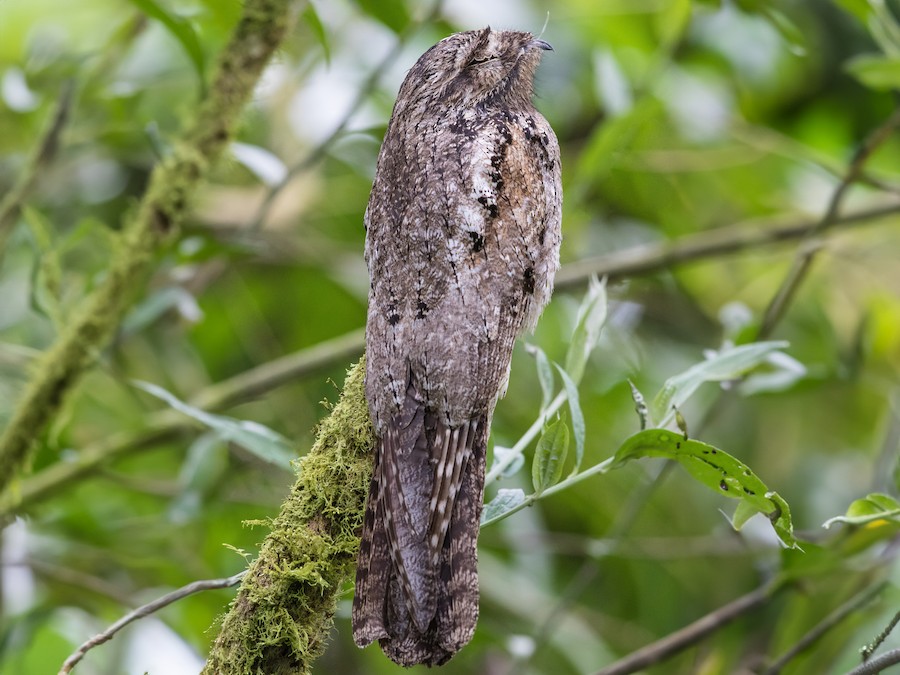
The master of camouflage through mimicry. The plumage is grayish-brown with complex markings of black, white and ocher that exactly reproduce the texture of bark and the dead wood of a stump. By day it perches vertically on the tip of a branch or a broken trunk, with eyes half-closed and body rigid, practically impossible to distinguish from the tree. Only its large yellow eyes give it away. It measures 33 to 38 cm. Its nocturnal song, a long descending lament, inspires legends throughout the region.
Behaviour
Nocturnal and insectivorous. It comes out at nightfall to hunt moths and other large insects, catching them in the air with its enormous mouth, which it can open wide. It is the only species of its family regularly present in the Iberá. It builds no nest: it lays a single egg directly on a horizontal branch.
How and when to see it
Nocturnal. By day, if you know where to look, it is possible to see its motionless silhouette at the end of an upright branch. At dusk it can be detected when it begins to sing before it grows fully dark.
Where to see it in the Iberá
The gateways of the Great Iberá Park where common potoo has confirmed presence:
Tours to see it
Verified providers operating at the gateways where common potoo lives. You contact them directly on WhatsApp from the app.
- Esteros Ñe’é
Experiences with local storytelling and a cultural take on the marshes.★ 5.0 - Gaucho Argentino
Horseback journeys across a network of refuges in Iberá. Multi-day rides with overnight…★ 5.0 - Jurassic Plant - Night Tour
The only carnivorous-plant garden in Argentina and a pioneer in Latin America. A guided…★ 5.0 - Irupé Excursiones
Guided hiking. Guided visit to museums, historic sites, chapels and trails of the town…★ 5.0
Species profile
- Common nameCommon Potoo
- Scientific nameNyctibius griseus
- GroupBird
- StatusNative
Other species of the Iberá
Discover all the wildlife of the Iberá
More than 250 species with photos, profiles and the gateways where you can see them. Map, providers and trip planner. Free, no download needed.
Open Iberá Experience