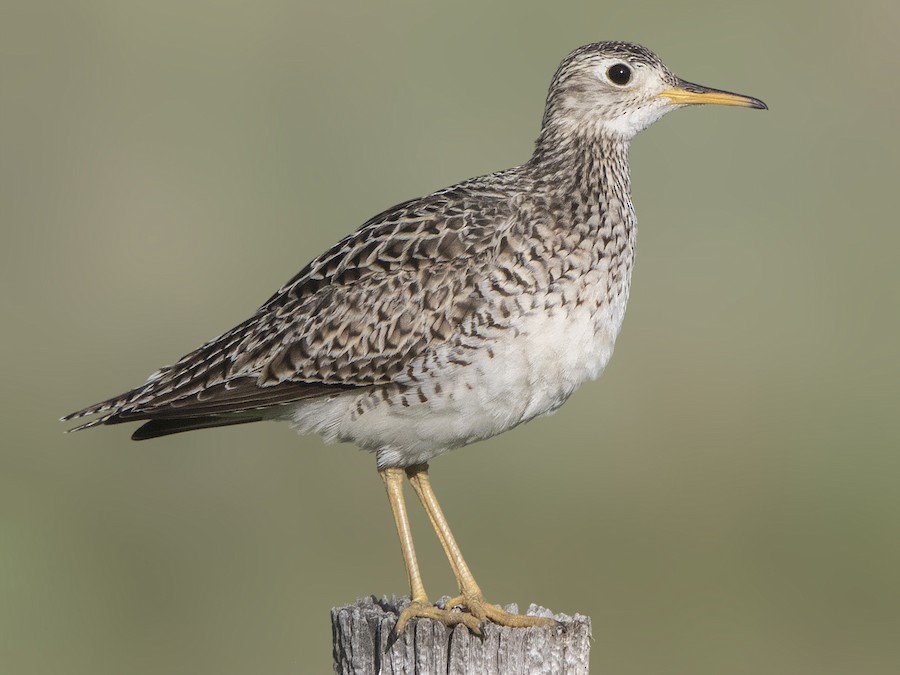
A medium-sized shorebird with an unusual silhouette: a very long neck, a small head with large, expressive eyes, a plump body and a long tail. The plumage is brown with well-defined dark spots and streaks; the belly whitish. In flight it shows downcurved wingtips, a diagnostic feature. It measures 28 to 32 cm. It migrates from the grasslands of North America to South America, using the natural grasslands of the Iberá during the austral summer (its non-breeding season).
Behaviour
It walks with an elegant, upright gait through the short grasslands, at times giving the impression of "stretching its neck" to see over the grass. Diet: large insects, earthworms and larvae. On landing, it raises its wings vertically for a moment before folding them.
How and when to see it
Spring and summer (October to March), its time in the southern hemisphere. In the short grasslands of Portals San Nicolás and Mburucuyá.
Where to see it in the Iberá
The gateways of the Great Iberá Park where upland sandpiper has confirmed presence:
Tours to see it
Verified providers operating at the gateways where upland sandpiper lives. You contact them directly on WhatsApp from the app.
- Excursiones Yetapá (Eduardo Alegre)
Excursions in the Iberá based in San Miguel, run by licensed guide Eduardo (Gualo)…★ 5.0 - La Tata en Yvera
Excursions and sport fishing in the Iberá Wetlands, based in San Miguel, the access town…★ 4.9 - Experiencia Corrientes
Tour operator based in San Miguel. Excursions and experiences through the San Nicolás…★ 4.8 - Establecimiento Las Marías
Guided tours of the yerba mate estate in Gobernador Virasoro, with a grill restaurant on…★ 4.6
Species profile
- Common nameUpland Sandpiper
- Scientific nameBartramia longicauda
- GroupBird
- StatusNative
Other species of the Iberá
Discover all the wildlife of the Iberá
More than 250 species with photos, profiles and the gateways where you can see them. Map, providers and trip planner. Free, no download needed.
Open Iberá Experience