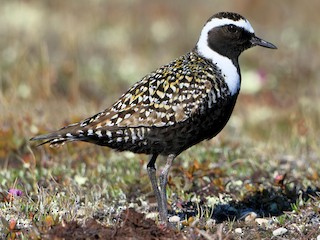
A long-distance migratory plover that breeds in the Arctic tundra of Canada and Alaska and migrates to South America. In non-breeding plumage (the austral winter) the plumage is brown with golden spots, a whitish belly and a brown crown with a white supercilium. In breeding plumage (rarely seen in the Iberá) the belly and breast are glossy black. It measures 23 to 28 cm. One of the longest-distance migrants among the vertebrates.
Behaviour
During migration it forages in groups in short grasslands, grazing fields and lagoon edges. It eats insects, earthworms and small seeds. It sometimes mixes with lapwings and other plovers in the damp grasslands of the Iberá.
How and when to see it
Autumn and spring during migration (March to May, and August to October). In the austral summer (January and February) some non-breeding individuals remain in the Iberá. Portal Mburucuyá and San Nicolás.
Where to see it in the Iberá
The gateways of the Great Iberá Park where american golden-plover has confirmed presence:
Tours to see it
Verified providers operating at the gateways where american golden-plover lives. You contact them directly on WhatsApp from the app.
- Jurassic Plant - Night Tour
The only carnivorous-plant garden in Argentina and a pioneer in Latin America. A guided…★ 5.0 - Guyra Wild Guides - Birding
Birdwatching tour and photo safari with specialized ornithologist guides. Yamil and…★ 5.0 - SKYVY - Astrotourism
Astrotourism in Loreto, 17 km from the San Antonio portal. Night-sky observation with a…★ 5.0 - Raíz del Monte
Private nature reserve in Loreto. Trails through the native woodland, wildlife watching…★ 5.0
Species profile
- Common nameAmerican Golden-Plover
- Scientific namePluvialis dominica
- GroupBird
- StatusNative
Other species of the Iberá
Discover all the wildlife of the Iberá
More than 250 species with photos, profiles and the gateways where you can see them. Map, providers and trip planner. Free, no download needed.
Open Iberá Experience