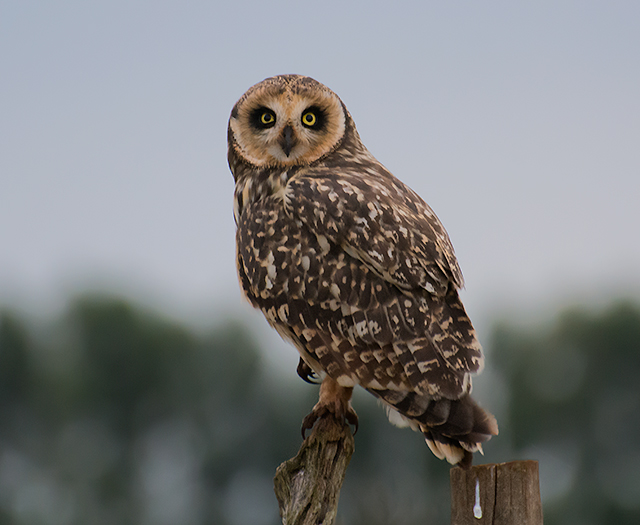
A medium-sized owl with streaked brown plumage in ocher, black and white tones that mimics the dry tussock grasslands. The eyes are intense yellow with a black-and-white facial ring. The "ears" are very small and almost imperceptible. The wings are long. It measures 34 to 42 cm. One of the few mainly diurnal owls, active above all at dawn and dusk. The South American population is resident; it moves locally following the abundance of rodents.
Behaviour
It hunts by flying low and slowly over the grasslands, often gliding with its wings raised in a slight V. It detects prey mainly by hearing, thanks to its amplifying facial discs. It eats almost exclusively small rodents, which makes it a natural controller of mouse populations in the grasslands.
How and when to see it
Spring and early summer, when the records in Corrientes are concentrated. At dawn and dusk over the open grasslands of the San Nicolás and Mburucuyá portals: it also hunts by day, which makes it one of the easiest owls to spot.
Where to see it in the Iberá
The gateways of the Great Iberá Park where short-eared owl has confirmed presence:
Tours to see it
Verified providers operating at the gateways where short-eared owl lives. You contact them directly on WhatsApp from the app.
- Esteros Ñe’é
Experiences with local storytelling and a cultural take on the marshes.★ 5.0 - Reserva Estero Camba Trapo
Private nature reserve of Ecoposada del Estero, on the Camba Trapo road. One of the…★ 5.0 - Excursiones Yetapá (Eduardo Alegre)
Excursions in the Iberá based in San Miguel, run by licensed guide Eduardo (Gualo)…★ 5.0 - Cabalgata Cintia
Horseback rides around Carlos Pellegrini.★ 5.0
Species profile
- Common nameShort-eared Owl
- Scientific nameAsio flammeus
- GroupBird
- StatusNative
Other species of the Iberá
Discover all the wildlife of the Iberá
More than 250 species with photos, profiles and the gateways where you can see them. Map, providers and trip planner. Free, no download needed.
Open Iberá Experience