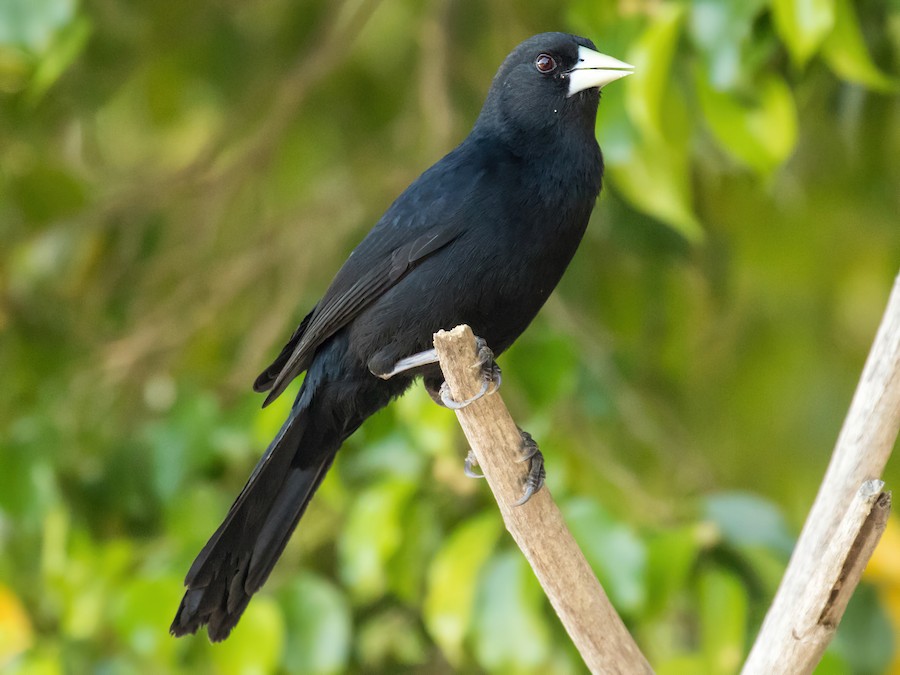
An icterid, 24 to 28 cm, entirely black with a metallic blue-green sheen on the plumage. Its most striking feature is the long, straight, bright ivory-white bill that contrasts with the black plumage. The eyes are dark. It inhabits the gallery forest and the woodland with large trees near water. Unlike most oropendolas and caciques, it is solitary and not very noisy, which makes it harder to find.
Behaviour
Solitary or in pairs. It moves through the canopy and high understory of the forest, searching for insects, fruit and nectar. The nest is a hanging bag of plant fibers, 20 to 40 cm long, that it builds on the high branches. The song is soft and infrequent for an icterid. The ivory bill makes it unmistakable.
How and when to see it
Year-round in the gallery forest. Best detected by seeing the white bill moving among the dark foliage. Portal Galarza and San Antonio.
Where to see it in the Iberá
The gateways of the Great Iberá Park where solitary black cacique has confirmed presence:
Tours to see it
Verified providers operating at the gateways where solitary black cacique lives. You contact them directly on WhatsApp from the app.
- Esteros Ñe’é
Experiences with local storytelling and a cultural take on the marshes.★ 5.0 - Jurassic Plant - Night Tour
The only carnivorous-plant garden in Argentina and a pioneer in Latin America. A guided…★ 5.0 - Guyra Wild Guides - Birding
Birdwatching tour and photo safari with specialized ornithologist guides. Yamil and…★ 5.0 - SKYVY - Astrotourism
Astrotourism in Loreto, 17 km from the San Antonio portal. Night-sky observation with a…★ 5.0
Species profile
- Common nameSolitary Black Cacique
- Scientific nameCacicus solitarius
- GroupBird
- StatusNative
Other species of the Iberá
Discover all the wildlife of the Iberá
More than 250 species with photos, profiles and the gateways where you can see them. Map, providers and trip planner. Free, no download needed.
Open Iberá Experience